Fulfillment
Canadian Fulfillment After Section 321: Why In-Country Inventory Is Now the Baseline

Cross-border ecommerce fulfillment has become significantly more complex for brands shipping into Canada, particularly since the Section 321 de minimis suspension in August 2025. What was once a straightforward path—shipping individual orders from US warehouses directly to Canadian consumers—now involves formal customs entries, duties on every shipment, and unpredictable delivery timelines that frustrate customers and erode margins. For brands serious about the Canadian market, the calculus has shifted. Positioning inventory within Canada is no longer a growth optimization; it is becoming a baseline requirement for competitive operations.
The guidance below is written for established D2C brands moving roughly 500 or more Canadian orders a month—the point at which the economics of holding inventory in-country typically start to work—and for the health, beauty, food, and natural health product brands whose regulatory obligations make the decision more complicated than a simple freight calculation.

The Post-Section 321 Reality for Cross-Border Fulfillment
Before August 2025, many US brands relied on Section 321 de minimis provisions to ship low-value orders into Canada without formal customs entries. That path is now closed. Every shipment crossing the border requires customs clearance, which means duties, brokerage fees, and processing delays that can add days to delivery timelines.
The practical impact is significant. A Canadian customer ordering from a US-based brand now faces:
- Customs duties and taxes calculated on product value plus shipping
- Brokerage fees that can exceed the cost of the product for small orders
- Delivery windows that stretch well beyond the two to three days those customers were used to
- Unpredictable timelines that damage customer trust
For brands competing against Canadian retailers offering next-day delivery, this gap is not sustainable. The solution is straightforward in concept but requires careful execution: position inventory within Canada and fulfill domestically.
In-Country Fulfillment: The Core Advantage
When inventory sits in Canadian warehouses, orders ship as domestic parcels. No customs entries. No duties. No brokerage surprises. A customer in Vancouver receives their order in a comparable timeframe to a customer in Toronto—typically one to two business days via ground shipping.
The operational benefits compound:
- Domestic shipping rates — Canadian carriers price domestic parcels significantly lower than cross-border shipments
- Predictable delivery timelines — Ground shipping across Canada follows established transit maps without customs variability
- Faster order-to-delivery cycles — Same-day fulfillment for orders received by cutoff times means next-day arrival for nearby customers
- Simplified returns — Canadian return addresses eliminate cross-border friction for reverse logistics
The trade-off is inventory investment. Brands must commit stock to Canadian warehouses, which requires forecasting, capital allocation, and coordination with existing supply chains. For brands processing 500+ orders monthly into Canada, this investment typically pays back within months through reduced shipping costs and improved customer retention.
Distributed Fulfillment Networks and Geographic Coverage
Canada spans six time zones. A single warehouse in Toronto cannot provide two-day ground delivery to Vancouver or Halifax without premium shipping services. This geographic reality drives the need for distributed fulfillment networks.
Strategic warehouse positioning typically involves:
- Central/Eastern hub — Ottawa or Toronto for Ontario, Quebec, and Atlantic provinces
- Western hub — Vancouver for British Columbia, Alberta, and the prairie provinces
With inventory positioned in both regions, brands can reach the large majority of Canadian consumers on ground service in one to two business days, rather than paying expedited rates to move every western order out of an eastern warehouse. Ground service costs a fraction of expedited air, and that gap widens the further a parcel travels—which is precisely why single-warehouse networks get expensive as a brand’s customer base spreads across the country.
Inventory allocation between locations requires data. Order history by province, seasonal patterns, and product velocity all inform how stock should be split. Modern warehouse management systems provide real-time visibility across locations and automate reorder triggers based on consumption rates.
Same-Day Fulfillment and Cutoff Time Discipline
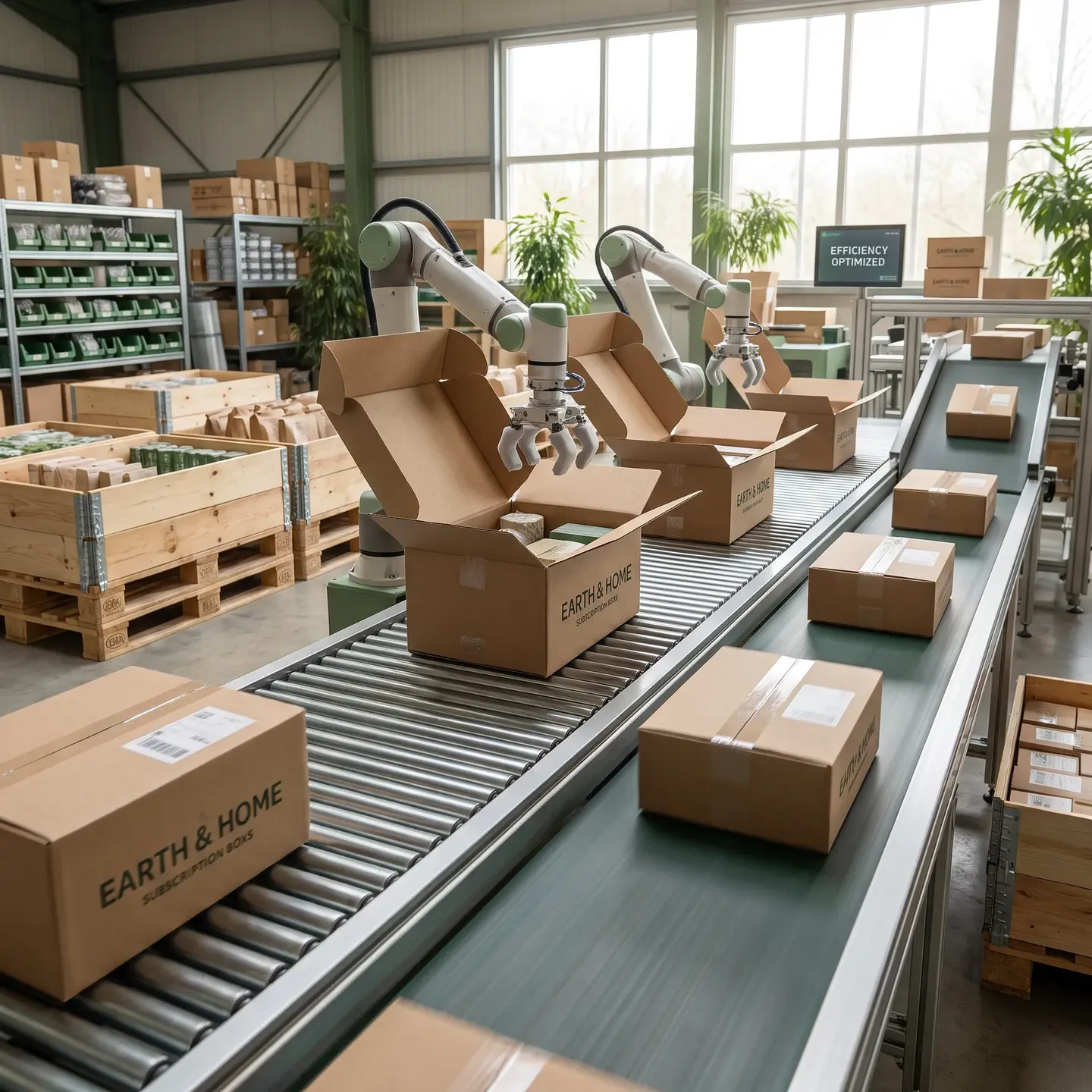
Customer expectations have compressed dramatically. Two-day delivery is now baseline; next-day is preferred. Meeting these expectations without premium shipping costs requires same-day fulfillment—orders received before a cutoff time ship the same day.
The cutoff time matters. A 1:30 PM EST cutoff provides enough processing buffer for pick, pack, and carrier handoff while still catching afternoon carrier pickups. Orders received at 1:29 PM ship today. Orders received at 1:31 PM ship tomorrow. This discipline requires tight warehouse operations:
- Order queuing systems that prioritize by cutoff proximity
- Pick and pack workflows optimized for throughput, not batch size
- Carrier pickup windows coordinated with fulfillment capacity
- Exception handling protocols for orders with special requirements
According to industry benchmarks, well-performing ecommerce operations typically target order accuracy rates above 99.7% and on-time shipping rates around or above 99%. These are not aspirational figures—they represent the threshold for competitive operations.
Carrier Rate Shopping: Optimizing Cost and Speed
No single carrier offers the best rate for every shipment. Package weight, dimensions, destination zone, and service level all influence which carrier provides optimal value for a specific order. Multi-carrier rate shopping addresses this complexity by comparing options in real time and selecting the best fit.
In practice, the engine evaluates each order against every eligible carrier before a label is generated. It works from billable weight rather than scale weight, since dimensional weight rules differ by carrier and can change which option is cheapest for a light but bulky parcel. It layers on the surcharges that sit above base rates—fuel, residential delivery, remote-area, oversize, and peak-season fees—because a carrier with the lowest published rate frequently isn’t the lowest once those are applied. Business rules then constrain the field: certain SKUs cannot move with certain carriers, some destinations are better served regionally, and some brands commit volume under negotiated agreements. What wins is the carrier with the lowest true landed cost that still meets the delivery promise made at checkout.
US benchmarks suggest that effective rate shopping can reduce annual shipping spend by roughly 21%. Canadian results will differ given a different carrier mix and zone structure, and actual savings depend heavily on package profile and how widely orders are distributed. A network including FedEx, UPS, Canada Post, Canpar, GLS, and UniUni covers the full spectrum from lightweight parcels to oversized packages, from rural deliveries to urban express.
The key insight is that rate shopping happens per shipment, not per carrier contract. A brand might route the bulk of its lightweight volume through Canada Post while sending heavy packages via Canpar—all without manual intervention.
Regulated Products Change the Calculus
Health, beauty, food, and natural health product brands carry obligations that a standard fulfillment operation is not built to meet, and those obligations should shape the shortlist before price ever enters the conversation. Under the Natural Health Products Regulations, a Health Canada site licence is required to manufacture, package, label, or import NHPs for sale in Canada—so a 3PL that imports on a brand’s behalf, or that packages or labels product, needs one for that site. Distributors are not licensed for distribution itself, but they remain bound by Good Manufacturing Practices covering storage, handling, and delivery, and must maintain distribution records and recall capability. Food operations add CFIA requirements around storage conditions, allergen segregation, and unbroken temperature control for cold chain items. Cosmetics require climate-controlled storage, lot tracking, and responsible-person documentation, with special handling for formulations containing flammable ingredients.
Each of these categories deserves more detail than a general guide can give it. We’ve covered them individually: NHP fulfillment compliance requirements, CFIA food fulfillment requirements, and cosmetics fulfillment and Health Canada requirements. Across all three, the practical advice is the same: ask for documented certifications rather than assurances. Third-party audit credentials such as Intertek SAI Global certification for storage and distribution of ambient food items and natural health products give you something verifiable, with a defined scope and expiry date you can check.
Kitting and Assembly for Subscription and Bundle Operations
Subscription boxes and product bundles require kitting—pre-assembling multiple SKUs into a single sellable unit. Instead of picking each component separately when an order arrives, fulfillment teams assemble combinations in advance according to standardized specifications.
The benefit is straightforward: a pre-built kit is picked as one item instead of five or eight, which removes most of the travel and handling time from the order. For subscription box companies shipping thousands of identical kits monthly, that difference compounds into meaningful labour savings and faster fulfillment cycles, particularly during the concentrated shipping windows that subscription programs tend to create.
Effective kitting requires:
- Bill of materials (BOM) documentation — Precise specifications for each kit including components, quantities, and arrangement
- Assembly workflow design — Station layouts optimized for the specific kit configuration
- Quality control checkpoints — Verification that assembled kits match specifications
- Inventory synchronization — Component-level tracking that updates as kits are built and shipped
For regulated products, kitting must incorporate compliance elements. Natural health product kits may require specific labeling and documentation. Cosmetics bundles need proper lot tracking across all components. Food kits must maintain allergen segregation and storage requirements. These constraints add complexity but are non-negotiable for compliant operations.
Platform Integration and Order Flow Automation
Manual order entry does not scale. Brands processing hundreds or thousands of orders daily need automated connections between their ecommerce platforms and fulfillment operations. Standard integrations include Shopify, WooCommerce, BigCommerce, Amazon, and NetSuite, with custom API options for specialized systems.
Effective integration provides:
- Real-time order import — Orders flow automatically from storefront to warehouse management system
- Inventory synchronization — Stock levels update across all sales channels as orders ship and inventory arrives
- Tracking distribution — Shipping confirmations and tracking numbers push back to customers automatically
- Exception flagging — Orders with issues (address problems, out-of-stock items) surface for resolution
The goal is removing manual touchpoints that create delays and errors. When a customer places an order on Shopify at 10 AM, that order should appear in the fulfillment queue within minutes, not hours. When it ships, the tracking number should reach the customer’s inbox before they think to check.
Bilingual Operations for Canadian Market Coverage
Canada’s bilingual requirements are not cosmetic. Quebec consumers expect French-language communications, and Consumer Packaging and Labelling Act regulations require bilingual labeling for many product categories. Fulfillment operations serving the Canadian market need bilingual capability across customer-facing touchpoints.
This includes:
- Packing slips and documentation in the customer’s preferred language
- Customer service support in both English and French
- Regulatory-compliant labeling for products requiring bilingual presentation
For US brands entering Canada, bilingual operations may be unfamiliar territory. Partnering with fulfillment providers who maintain bilingual teams simplifies compliance and improves customer experience in Quebec—Canada’s second-largest consumer market.
Evaluating Your Current Operations

Brands can use several benchmarks to assess whether their fulfillment operations meet competitive standards:
- Order accuracy — Well-performing operations target 99.7% or higher, consistent with the benchmark cited above. If your error rate approaches 1%, picking and packing processes need attention.
- Same-day ship rate — For in-stock items ordered before cutoff, same-day shipping should approach 95% or higher.
- Inventory accuracy — System records should match physical stock at 99% or better. Frequent stockouts for common items signal inventory management problems.
- Delivery timeline predictability — If customers routinely experience delays beyond estimated delivery dates, carrier selection or fulfillment timing may be misaligned.
Gaps in these metrics represent opportunities. Sometimes the issue is process design. Sometimes it is technology. Sometimes it is the fulfillment partner itself. Honest assessment precedes effective improvement.
Making the Transition
Moving from cross-border shipping to in-country Canadian fulfillment requires planning but is not inherently complex. The typical transition involves:
- Inventory forecasting — Determining how much stock to position in Canada based on order history and growth projections
- Customs clearance for bulk import — Working with customs brokers to clear inventory shipments into Canada properly
- Platform integration — Connecting ecommerce systems to the Canadian fulfillment operation
- Parallel operation — Running Canadian fulfillment alongside existing operations during transition
- Cutover — Routing Canadian orders to in-country fulfillment exclusively
For brands with regulatory requirements—NHP, food, cosmetics—the transition must also confirm that the Canadian fulfillment partner holds appropriate licenses and certifications. Verifying these credentials upfront prevents compliance issues downstream.
The Canadian market represents significant opportunity for US and international ecommerce brands. Population concentration in major urban areas, high ecommerce adoption rates, and consumer expectations aligned with US norms make Canada accessible for brands with the right fulfillment infrastructure. The post-Section 321 environment has raised the barrier to entry, but brands willing to invest in in-country operations can build sustainable competitive positions. The question is not whether to serve Canadian customers—it is whether to serve them well enough to keep them.
Frequently Asked Questions
Since the August 2025 Section 321 suspension, every order crossing into Canada now requires formal customs clearance, which means duties, brokerage fees, and added delays for each shipment, making direct US-to-Canada parcel shipping slower, more expensive, and less predictable for your customers.
If you’re consistently processing around 500+ Canadian orders per month, positioning inventory in Canadian warehouses usually pays off within a few months through lower domestic shipping rates, faster 1–2 day delivery, and higher customer retention compared to cross-border shipping.
Yes, if you want 1–2 day ground coverage for most of Canada, you typically need at least a central/eastern hub (e.g., Toronto or Ottawa) plus a western hub (e.g., Vancouver) so you’re not paying premium rates to rush orders across six time zones.
Disciplined same-day fulfillment is key: set a clear order cutoff time (for example, 1:30 PM EST), build workflows to ship all in-stock orders received before that cutoff the same day, and align carrier pickups so you consistently achieve 99%+ on-time ship rates.
Make sure they hold the required Health Canada Site License and relevant CFIA-compliant certifications, can provide temperature- and humidity-controlled storage, lot and batch tracking, FEFO picking, and documented processes that support inspections and recalls for your specific product category.

Scale Your Canada Fulfillment with Confidence.
Partner with Canada's premier 3PL to unlock faster shipping, lower costs, and seamless scalability for your ecommerce brand.
Talk to an Expert