Fulfillment
Shopify Fulfillment Options: Comparing SFN, 3PLs, and Self-Fulfillment for Growing Merchants

For Shopify merchants navigating growth, fulfillment strategy represents one of the most consequential operational decisions affecting customer satisfaction, unit economics, and scalability. The choice between managing fulfillment internally, leveraging the Shopify Fulfillment Network, or partnering with a specialized third-party logistics provider shapes everything from delivery speed and shipping costs to your capacity for expansion into new markets. What works brilliantly at 200 orders per month often becomes a significant constraint at 2,000—and the approach that serves domestic fulfillment may prove inadequate when customers in new geographic markets expect the same delivery experience. We’ve worked with hundreds of Shopify merchants at various growth stages, and what we’ve observed is that the “best” fulfillment option isn’t universal—it depends entirely on your specific business profile, product requirements, and growth trajectory.
Who This Guide Is For
This comparison is designed for established Shopify merchants processing 500 or more orders monthly who are actively evaluating whether their current fulfillment approach can sustain their growth. If you’re experiencing any of the following, this analysis will help you determine your optimal path forward:

- Your current fulfillment operation struggles during peak periods or promotional spikes
- You’re considering expansion into the Canadian market from the United States or internationally
- Your products require regulatory compliance (natural health products, food, cosmetics) that adds fulfillment complexity
- Shipping costs are compressing your margins as carrier rates continue rising
- Customer expectations for delivery speed exceed what your current setup can consistently provide
This guide is not intended for merchants under 100 orders monthly who haven’t yet reached the volume thresholds where fulfillment outsourcing typically becomes cost-effective, nor for marketplace-only sellers whose fulfillment is already managed through Amazon FBA or similar programs.
The Shopify Fulfillment Landscape: Understanding Your Options
Shopify merchants have three primary fulfillment pathways, each representing distinct trade-offs between control, cost, scalability, and capability. Understanding these trade-offs clearly is essential before evaluating which approach fits your business.
Self-fulfillment means you manage every aspect of order processing, inventory storage, picking, packing, and shipping from your own facilities or workspace. You maintain complete control over the customer experience but absorb all operational complexity and capital requirements.
Shopify Fulfillment Network connects your store with vetted fulfillment partners through Shopify’s ecosystem, providing unified management through your admin dashboard and access to distributed inventory positioning through network partners.
Specialized third-party logistics (3PL) providers operate independently of platform networks, offering vertical expertise in specific product categories, geographic optimization for particular markets, and advanced capabilities like cross-border customs management and regulated product fulfillment.
Most merchants follow a natural evolution: starting with self-fulfillment during early growth stages, evaluating outsourcing as volume increases and operational demands compound, and ultimately choosing between platform-integrated networks and specialized partners based on their specific requirements. The critical insight is that this isn’t a hierarchy of quality—it’s a spectrum of fit.
Shopify Fulfillment Network: Capabilities, Limitations, and Ideal Use Cases
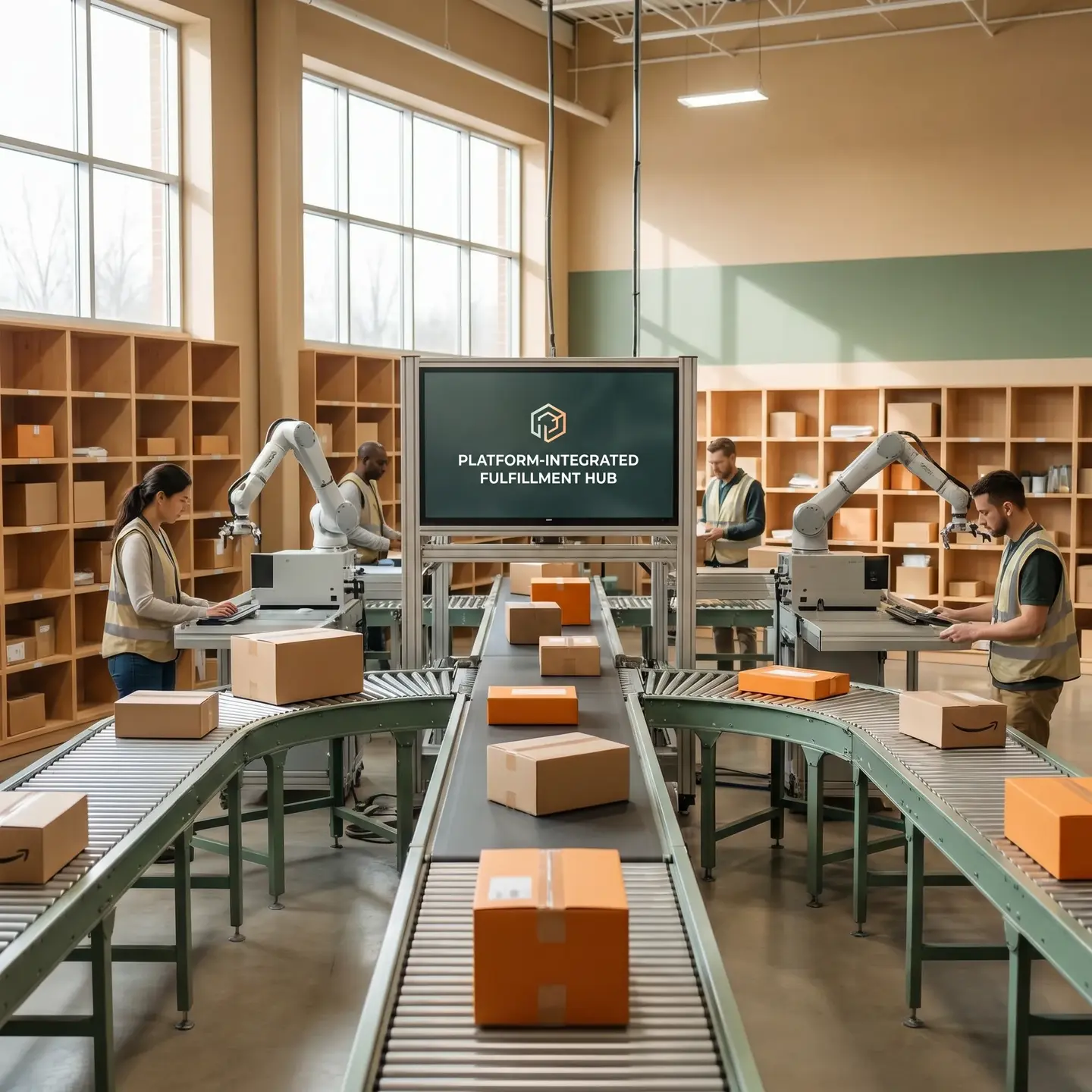
The Shopify Fulfillment Network represents Shopify’s approach to simplifying fulfillment through strategic partnerships with established logistics providers. Through fulfillment service apps, merchants connect with trusted 3PL partners who manage inventory positioning and shipping from fulfillment centers strategically located to serve customer concentrations.
Key Strengths of Platform-Integrated Fulfillment
The primary advantage of working within Shopify’s fulfillment ecosystem is operational simplicity. Your fulfillment management integrates directly into the admin interface you already use daily. Order routing, inventory visibility, and shipping status updates flow through familiar dashboards without requiring separate logins to external systems.
Partner vetting provides baseline quality assurance. Shopify’s network partners have met platform requirements, reducing some of the due diligence burden that comes with independently sourcing fulfillment partners. For merchants without deep logistics expertise, this curation offers meaningful risk reduction.
Distributed inventory positioning through network partners enables you to store products closer to customer concentrations, potentially reducing shipping zones and transit times compared to single-location fulfillment.
Limitations to Consider
Platform networks operate within defined parameters that may or may not align with your specific requirements:
- Geographic constraints: Partner availability varies by region. Merchants targeting Canadian customers, for instance, may find limited options for domestic Canadian fulfillment within the network, potentially requiring cross-border shipping that adds cost, customs complexity, and delivery delays.
- Volume thresholds: Certain network partners maintain minimum order requirements that may exceed what early-stage merchants can commit to, or may not scale economically for very high-volume operations.
- Capability boundaries: Regulated product handling, specialized kitting requirements, or complex compliance needs may exceed standard partner capabilities. If your products require Health Canada compliance, CFIA food handling certifications, or specialized storage conditions, you’ll need to verify that network partners can accommodate these requirements.
- Customization limits: Network partnerships prioritize standardization for efficiency, which can constrain brands requiring highly customized packaging, unique unboxing experiences, or non-standard fulfillment workflows.
Ideal Merchant Profile for SFN
The Shopify Fulfillment Network tends to work well for merchants who prioritize platform-native integration simplicity, operate primarily within the United States where partner density is highest, sell non-regulated products with standard handling requirements, and have order volumes that align with network partner minimums without requiring highly specialized capabilities.
Third-Party Logistics for Shopify: When Specialized 3PLs Make Sense
While platform networks offer convenience through integration, specialized 3PLs provide depth through focused expertise. The decision to partner with a 3PL outside platform networks typically stems from requirements that exceed what standardized fulfillment partnerships can accommodate.
Cross-Border Fulfillment Expertise
For US brands expanding into Canada—or international brands targeting North American markets—cross-border fulfillment introduces complexity that generic fulfillment partners often struggle to manage effectively. The suspension of Section 321 de minimis treatment in August 2025 fundamentally changed the economics of shipping directly to Canadian customers from US facilities. What previously allowed duty-free entry for shipments under $800 USD now requires customs compliance expertise and strategic inventory positioning to maintain competitive delivery costs and timelines.
Specialized 3PLs with Canadian fulfillment infrastructure enable you to position inventory within Canada, converting international shipments into domestic orders. This approach eliminates customs delays at the border, provides access to domestic carrier rates, and delivers the 1-2 day ground delivery timelines Canadian consumers expect. Our facilities in Ottawa, Toronto, and Vancouver provide distributed coverage that reaches most Canadian consumers within this window—without the premium shipping costs that erode margins when shipping cross-border.
Regulated Product Handling
Health, beauty, food, and natural health product brands face fulfillment requirements that extend well beyond standard pick-and-pack operations. Health Canada compliance, CFIA food handling certifications, proper documentation, and quality management systems aren’t optional considerations—they’re regulatory requirements that can result in product seizures, import refusals, or market access revocation if mishandled.
Specialized 3PLs serving regulated product categories maintain the certifications, facilities, and operational procedures these products demand. Our Intertek SAI Global certification with a 100% Superior rating (valid through August 2027) documents the compliance infrastructure that health, beauty, and food brands require. When evaluating fulfillment partners for regulated products, verified compliance capability—not just claimed capability—should be non-negotiable.
Advanced Operational Capabilities
Beyond geographic and regulatory requirements, specialized 3PLs often provide capabilities that exceed platform network standards:
- Carrier rate shopping: Automated comparison across multiple carriers (we optimize across FedEx, UPS, Canada Post, Canpar, GLS, and UniUni) identifies the most cost-effective shipping option for each order based on destination, weight, and service requirements.
- Same-day fulfillment windows: Our 1:30 PM EST cutoff for same-day processing ensures orders placed in the morning ship the same business day—a capability that directly impacts customer satisfaction and competitive positioning.
- Kitting and assembly at scale: Subscription box operations, bundled product offerings, and promotional kits require fulfillment partners capable of managing complex bills of materials and variable assembly requirements.
- Bilingual operations: For the Canadian market specifically, English and French operational capability ensures compliance with packaging requirements and customer communication expectations.
Ideal Merchant Profile for Specialized 3PLs
Specialized 3PL partnerships typically deliver the greatest value for merchants expanding into specific geographic markets requiring local fulfillment infrastructure, selling regulated products that demand documented compliance capabilities, processing volumes where carrier rate optimization and fulfillment efficiency materially impact unit economics, and requiring customized fulfillment workflows that exceed standardized network partner capabilities.
Self-Fulfillment: When Keeping It In-House Works
Despite the industry’s general movement toward outsourced fulfillment, self-fulfillment remains the appropriate choice for certain merchant profiles. Acknowledging when in-house operations make sense builds credibility for the broader comparison—and helps you make an informed decision rather than defaulting to outsourcing prematurely.
Scenarios Where Self-Fulfillment Makes Sense
Early-stage volume: Merchants processing fewer than 300-500 orders monthly often find that 3PL minimums don’t justify outsourcing costs. The fixed overhead of external partnerships may exceed the operational burden of managing fulfillment internally at lower volumes.
Highly customized packaging: Brands where the unboxing experience represents a core differentiator—artisan products, luxury goods, or heavily personalized items—may require direct oversight that outsourced fulfillment cannot replicate with the necessary consistency.
Local customer concentration: If your customer base is geographically concentrated near your existing operations, centralized self-fulfillment may provide adequate service levels without the complexity of distributed inventory or external partnerships.
Existing infrastructure: Merchants with established warehouse facilities, trained staff, and fulfillment expertise may find that utilizing existing capacity delivers better economics than paying external partners—particularly if that infrastructure would otherwise sit underutilized.
The Trade-Offs to Acknowledge
Self-fulfillment preserves operational control and potentially higher margins at lower volumes. However, this approach typically constrains scalability, particularly during peak seasons or promotional spikes. Carrier rate negotiation becomes challenging without aggregated volume. Geographic expansion requires proportional infrastructure investment. And perhaps most significantly, fulfillment management consumes founder or team bandwidth that might otherwise drive growth through product development, marketing, or customer acquisition.
The indicators that signal when self-fulfillment no longer serves your business include consistent month-over-month volume growth, fulfillment tasks consuming disproportionate team capacity, shipping costs exceeding industry benchmarks, delivery speeds falling behind competitor offerings, and error rates increasing during busy periods.
Decision Framework: Choosing the Right Fulfillment Approach
Rather than prescribing a single answer, this framework helps you identify which approach aligns with your specific circumstances.
Volume Thresholds
Under 300 orders/month: Self-fulfillment typically remains cost-effective unless specific capabilities (regulated product handling, cross-border compliance) require external expertise regardless of volume.
300-1,000 orders/month: Evaluation threshold. If operational strain is emerging, team capacity is constrained, or you’re preparing for significant growth, begin evaluating outsourcing options. Platform networks may provide adequate capability for straightforward fulfillment needs.
1,000+ orders/month: Outsourcing typically delivers meaningful advantages through carrier rate optimization, operational efficiency, and scalability headroom. The choice between platform networks and specialized 3PLs depends on your geographic strategy and product requirements.
Geographic Customer Distribution
Primarily US domestic: Platform networks and US-based 3PLs provide adequate options with established infrastructure.
Canadian market expansion: If you’re a US brand targeting Canadian customers, cross-border fulfillment for US brands through Canadian-based 3PLs eliminates the customs complexity, duty costs, and delivery delays that undermine customer experience when shipping internationally. This represents one of the clearest cases for specialized 3PL partnership rather than platform networks.
International expansion: Evaluate 3PLs with established presence in target markets rather than extending domestic fulfillment across borders.
Product Requirements
Standard merchandise: Platform networks and general 3PLs typically accommodate non-regulated products without specialized handling needs.
Regulated products: Natural health products, food and beverage, cosmetics, and medical devices require fulfillment partners with documented compliance infrastructure. Verify certifications and regulatory capabilities explicitly—claims without documentation should raise concerns.
Specialized handling: Temperature-sensitive products, fragile items, oversized goods, or products requiring assembly may require 3PLs with demonstrated capability in your specific product category.
Merchant Profile Examples
Profile A: A US-based apparel brand processing 800 orders monthly, shipping primarily to US customers, with standard products and no regulatory requirements. Likely fit: Shopify Fulfillment Network or general 3PL—platform integration simplicity provides value without requiring specialized capabilities.
Profile B: A natural health product brand processing 2,500 orders monthly, with significant Canadian customer growth and Health Canada compliance requirements. Likely fit: Specialized Canadian 3PL with documented NHP compliance—Shopify Fulfillment through a partner with Intertek certification and Health Canada expertise addresses both the regulatory and geographic requirements.
Profile C: An artisan jewelry brand processing 400 orders monthly with highly customized packaging and a local customer base. Likely fit: Self-fulfillment remains appropriate—the customization requirements and moderate volume don’t justify outsourcing trade-offs.
Making Your Decision
The fulfillment approach that serves your business today may not be the right choice in twelve months. Building in evaluation triggers—volume thresholds, operational strain indicators, geographic expansion plans—ensures you revisit this decision as circumstances evolve rather than allowing fulfillment to become a growth constraint by default.
For merchants who determine that specialized 3PL partnership aligns with their requirements—particularly those targeting Canadian market expansion, selling regulated products, or requiring Shopify fulfillment services with cross-border expertise—we welcome the opportunity to discuss how our infrastructure, capabilities, and experience might support your growth objectives. Our facilities in Ottawa, Toronto, and Vancouver, combined with our documented compliance certifications and carrier rate-shopping across six carriers, position us specifically to serve merchants whose analysis reveals that Canadian fulfillment optimization represents their strategic priority.
The right fulfillment decision isn’t about choosing the option with the most impressive marketing—it’s about matching your specific requirements to a partner whose capabilities genuinely align with your needs. We believe that informed merchants make better partners, which is precisely why we’ve presented this comparison with genuine objectivity rather than disguised promotion.
Frequently Asked Questions
Stick with self-fulfillment under 300 orders monthly if operations are simple. Evaluate outsourcing at 300-1,000 orders monthly when peaks cause strain or growth looms—platform networks like Shopify Fulfillment Network often fit here without heavy complexity.
They demand Health Canada compliance, CFIA certifications, and specialized storage. Verify partners have documented proofs like Intertek ratings, as standard network options often lack this, risking seizures or refusals at customs.
Choose SFN for US-focused, standard products needing simple admin integration. Go specialized 3PL for regulated goods, cross-border needs, or advanced features like carrier shopping and same-day cutoffs that boost margins at 1,000+ orders.
Network partners have limited Canadian options, forcing cross-border shipping with customs delays and higher costs. Opt for specialized 3PLs with local facilities in Ottawa, Toronto, or Vancouver for 1-2 day domestic delivery instead.
If you’re under 500 orders monthly with highly custom packaging, local customers, or existing warehouse space, in-house keeps control and margins tight. Watch for signs like peak errors or team overload to switch.

Scale Your Canada Fulfillment with Confidence.
Partner with Canada's premier 3PL to unlock faster shipping, lower costs, and seamless scalability for your ecommerce brand.
Talk to an Expert