Fulfillment
Peak Season Fulfillment Strategies 2026: AI Forecasting, Automation & Workforce Planning for D2C Brands

Peak season can define the trajectory of a direct-to-consumer brand’s entire year. When Black Friday arrives and order volumes surge 300-400% above normal, the difference between capturing record revenue and suffering catastrophic fulfillment failures often comes down to decisions made months earlier. For cross-border brands shipping into Canada, the stakes are even higher—customs clearance delays, transcontinental shipping distances, and unique market events like Boxing Day create complexity that domestic-focused strategies simply don’t address.
We’ve seen brands lose customers permanently because a single peak season shipment arrived late. We’ve also watched well-prepared operations transform Q4 surges into sustainable growth engines. The difference isn’t luck—it’s strategic preparation that combines proven fulfillment fundamentals with emerging AI forecasting and automation capabilities.

This guide provides the comprehensive framework operations managers and supply chain directors need to navigate peak season 2026 and beyond. We’ll move beyond generic advice into specific timelines, calculation frameworks, and technology strategies tailored for D2C brands managing Canadian fulfillment operations.
Who This Guide Is For (And Who It’s Not For)
This resource is designed for operations directors, supply chain managers, and founders at established D2C brands shipping into Canada—particularly those processing 500+ orders daily during normal operations and anticipating significant peak season volume increases. You should already understand fulfillment fundamentals and be looking for strategic frameworks rather than basic definitions.
This guide is not for:
- Brands just launching their first e-commerce operation
- Retailers focused primarily on brick-and-mortar with minimal online presence
- Companies seeking marketing or promotional strategy guidance
- Operations that don’t ship cross-border or don’t serve the Canadian market
If you’re navigating the complexity of international fulfillment during high-volume periods and want data-driven approaches to inventory positioning, workforce planning, and technology optimization, continue reading.
The Peak Season Landscape for Cross-Border D2C Brands
Q4 e-commerce sales in Canada represent approximately 28% of annual online retail revenue, according to Statistics Canada retail trade data. For cross-border D2C brands, this concentration of demand creates both opportunity and operational risk.
The Canadian peak season calendar differs from the US market in critical ways:
- Black Friday/Cyber Monday: Order volumes typically surge 320-400% above baseline
- Boxing Day: Often rivals Black Friday volumes, with strong year-over-year growth in online sales
- January returns surge: Creates a secondary operational peak requiring reverse logistics capacity
- Winter weather disruptions: Cross-country shipping faces delays that US-centric planning ignores
Cross-border brands face unique challenges that domestic operators don’t encounter. Customs clearance processing times increase significantly during November-December without strategic pre-positioning. Transcontinental distances mean that inventory positioned incorrectly can’t be redirected quickly enough to meet demand.
The consequences of poor preparation are severe. Research consistently shows that a majority of consumers will not return to a brand after a single negative delivery experience during peak season. When every competitor is fighting for the same customer during promotional periods, fulfillment failures don’t just cost one sale—they permanently damage brand relationships.
The 6-Month Peak Season Preparation Timeline
Effective peak season preparation starts in June for November-January execution. This reverse-engineered timeline provides specific milestones rather than vague “start early” advice.
June-July: Foundation Phase
- Conduct technology stack audit—identify system limitations before volume stress exposes them
- Analyze previous peak season data for forecast model training
- Initiate carrier contract negotiations for peak surcharge agreements
- Assess current warehouse capacity and identify expansion requirements
- Begin AI forecasting model development or refinement
August-September: Investment Phase
- Finalize inventory orders based on AI demand forecasts
- Implement automation upgrades with sufficient testing time
- Begin seasonal workforce recruitment
- Stress-test technology integrations (especially Shopify fulfillment integration and other platform connections)
- Pre-position inventory in strategic Canadian fulfillment centers
October: Readiness Phase
- Complete seasonal workforce training
- Finalize backup carrier relationships
- Conduct full system load testing
- Establish real-time monitoring dashboards and KPIs
- Confirm customs documentation and post-de minimis formal entry compliance procedures
November-January: Execution Phase
- Daily KPI monitoring and agile response protocols
- Real-time forecast adjustments based on actual demand signals
- Carrier performance tracking and backup activation if needed
- Returns processing capacity management
AI-Powered Demand Forecasting: Beyond Historical Averages
Traditional forecasting relies on historical sales data—last year’s Black Friday volumes plus a growth percentage. This approach consistently fails because it can’t account for changing market conditions, promotional timing variations, or emerging demand signals.
AI-powered demand forecasting analyzes multiple data sources simultaneously:
- Historical sales patterns: Not just totals, but SKU-level velocity, geographic distribution, and channel mix
- Market trend signals: Social media sentiment, search volume trends, competitor activity
- External factors: Weather patterns affecting purchasing behavior, economic indicators, promotional calendar alignment
- Real-time demand signals: Website traffic, cart abandonment rates, email campaign engagement
According to McKinsey supply chain analytics research, AI-powered forecasting reduces inventory prediction errors by 30-50% compared to traditional methods. Brands using predictive analytics consistently achieve significantly higher in-stock rates compared to those relying on historical averages alone.
Implementing AI Forecasting for Cross-Border Operations
For brands shipping into Canada, AI models must be trained on cross-border-specific data:
- Customs clearance timing patterns during different volume periods
- Geographic demand distribution across Canadian provinces
- Currency exchange rate impact on purchasing behavior
- Boxing Day demand patterns (often underestimated by US-focused models)
The forecast validation process should compare predictions against actual results at weekly intervals during the approach to peak season, allowing model refinement before high-stakes periods begin.
Strategic Inventory Positioning for Peak Season
Accurate demand forecasting only delivers value when inventory is positioned to meet that demand. For cross-border brands, this means strategic pre-positioning in Canadian fulfillment centers well before peak season begins.
Safety Stock Calculations for Peak Periods
Standard safety stock formulas must be adjusted for peak season variability. A basic framework:
Peak Safety Stock = (Maximum Daily Sales × Maximum Lead Time) – (Average Daily Sales × Average Lead Time) × Peak Volatility Factor
The peak volatility factor typically ranges from 1.3 to 1.8 depending on promotional intensity and historical demand variance. For cross-border operations, add additional buffer for customs clearance variability.
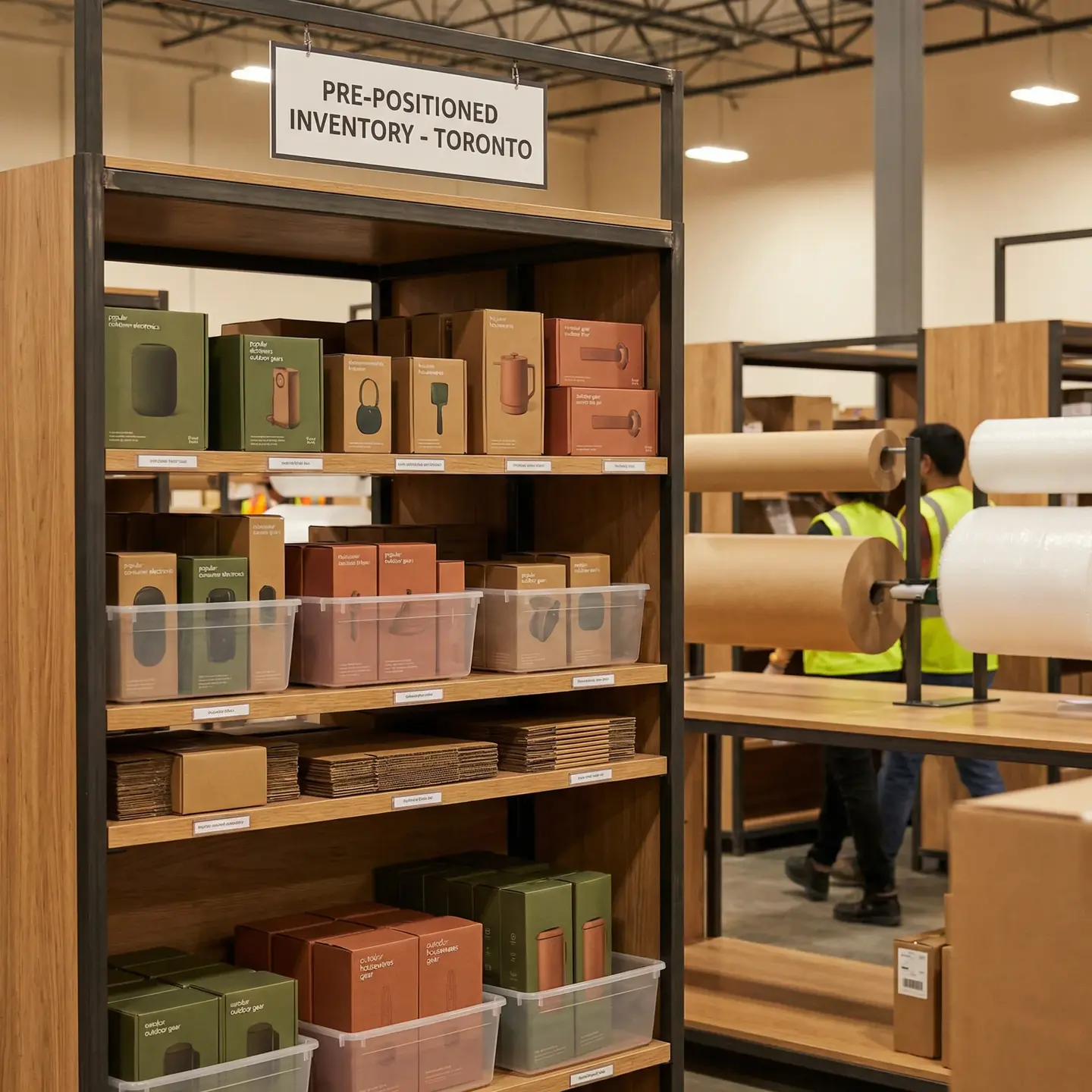
Pre-Positioning Strategy
Inventory shipped to Canadian fulfillment services locations before October avoids the customs delays that plague just-in-time approaches during peak. Key considerations include:
- Geographic distribution: Position inventory near major population centers (Toronto, Vancouver, Ottawa) to minimize final-mile transit times
- SKU velocity segmentation: High-velocity items require broader distribution; long-tail products can be centralized
- Overstock risk management: Balance stockout cost (lost sales + customer relationship damage) against carrying cost of excess inventory
Cross-border compliance during inventory positioning requires attention to CBSA cross-border trade requirements. Documentation errors during pre-positioning can create delays that cascade through peak season.
Warehouse Automation Technologies for Volume Surges
Automation investments must be evaluated based on peak season ROI, not just year-round volume. Technologies that deliver value during 320%+ volume surges include:
High-Impact Automation Solutions
- Pick-to-light systems: Reduce picker decision time and errors; typical improvement of 20-40% in picks-per-hour
- Automated conveyor systems: Eliminate walking time in high-velocity areas; essential for same-day fulfillment during peak
- Goods-to-person robotics: Bring products to stationary pickers; particularly effective for high-SKU-count operations
- Automated packing stations: Dynamic packaging selection reduces dimensional weight penalties, typically saving 5-12% on shipping costs
ROI Calculation Framework
Peak season automation ROI should consider:
- Labor cost reduction: Automation can reduce labor dependency by 40% during peak while increasing throughput
- Accuracy improvement: Reduced pick errors mean fewer returns and customer service costs
- Capacity expansion: Same footprint handles higher volume without facility expansion
- Speed improvement: Same-day order fulfillment capabilities can meaningfully increase conversion rates during peak promotional periods
Implementation timing is critical—new automation systems need 8-12 weeks of operation before peak season to resolve integration issues and optimize workflows.
Workforce Strategies: Blending Permanent Staff, Seasonal Workers, and Automation
Automation reduces but doesn’t eliminate labor requirements during peak season. The most effective operations blend permanent staff expertise, seasonal worker capacity, and technology in complementary ways.
Calculating Peak Labor Requirements
A basic framework for labor planning:
Peak Labor Hours = (Forecasted Orders × Average Processing Time per Order) / Target Productivity Rate
Critical adjustment: Temporary workforce productivity reaches only 60-70% of permanent staff efficiency during the first two weeks. This creates hidden capacity constraints if seasonal hiring occurs too late.
Recruitment and Training Timeline
- August: Begin recruitment for seasonal positions (competitive markets require 12-week lead time)
- September: First wave of seasonal hires begins training
- October: Second wave hiring; first wave reaches acceptable productivity levels
- November: Full workforce deployed with experienced permanent staff in supervisory roles
Cross-Training for Flexibility
Well-organized fulfillment centers typically see notable efficiency gains from multi-functional staff capabilities during peak surges. Cross-training permanent staff across picking, packing, and receiving functions creates flexibility to redirect labor based on real-time bottlenecks.
Wage considerations in the Canadian market require attention—competitive markets often require meaningful wage premiums to attract quality peak-season workers compared to baseline rates.
Technology Stack Optimization for Peak Performance
Technology failures during peak season are catastrophic. Systems that handle normal daily volumes often reveal limitations when order volumes surge 300%+.
Critical Integration Points
- E-commerce platform connections: Shopify, WooCommerce, and ERP integrations must handle order volume without lag
- Warehouse management system (WMS): Real-time inventory accuracy prevents overselling
- Order management system (OMS): Order routing and prioritization logic must scale
- Carrier integration: Label generation and manifest systems must process volume without bottlenecks
Stress Testing Protocol
- Simulate peak-level order volumes through complete system flow
- Identify processing time degradation at different volume levels
- Test failover procedures for critical system components
- Validate inventory sync accuracy under high-transaction conditions
- Confirm carrier rate shopping performs correctly with increased volume
Complete stress testing by mid-October allows time to address issues before they become peak season emergencies.
Carrier Strategy and Multi-Carrier Diversification
Single-carrier dependency creates unacceptable risk during peak season. When one carrier experiences capacity constraints or service failures, brands without backup relationships face delayed shipments and customer complaints.
Multi-Carrier Strategy Components
- Primary carrier relationship: Negotiated peak surcharge agreements and guaranteed capacity
- Secondary carrier partnerships: 2-3 backup options with pre-established accounts and rate agreements
- Regional specialists: Local carriers for final-mile delivery in specific Canadian markets
- Expedited options: Premium shipping alternatives for customer service recovery situations
Zone-Skipping Strategies
Zone-skipping—consolidating shipments and bypassing intermediate carrier zones—reduces costs during high-volume periods. With properly positioned Canadian inventory, cross-border brands can achieve significant per-package savings while maintaining delivery speed.
Early carrier commitment (Q2-Q3) to peak season agreements prevents the common 15-25% rate increases that brands face when negotiating capacity in October or November.
Post-De Minimis Cross-Border Compliance During Peak Season
Peak volume surges affect customs processing in ways that catch unprepared brands off guard. Documentation errors that cause minor delays during normal periods become catastrophic during peak season when every day affects customer satisfaction.
Peak Season Compliance Considerations
- Pre-clearance strategies: Ensure all documentation is prepared before shipments reach the border
- Classification accuracy: HS code errors trigger holds and audits—verify classifications well before peak
- Post-de minimis cost planning: With the global suspension of Section 321 de minimis effective August 29, 2025, all shipments entering the U.S. now require formal customs processing and full duty payment regardless of value—making accurate landed-cost calculations and compliance documentation essential
- Volume documentation: Increased shipment volume increases audit probability—maintain meticulous records
Brands that adapted early to the end of Section 321 de minimis—by pre-positioning inventory domestically, building accurate HS code classifications, and automating customs documentation—hold a meaningful cost and speed advantage over competitors still scrambling to adjust their cross-border workflows during peak season.
Real-Time Monitoring and Agile Response During Peak
Even the best preparation requires real-time monitoring and rapid response capability during execution. The brands that succeed during peak season establish clear KPIs, monitoring systems, and decision frameworks before volume surges begin.
Daily Monitoring KPIs
- Order processing time: Hours from order receipt to ship-ready status
- Pick accuracy rate: Target 99.5%+ during peak
- Ship-by cutoff adherence: Percentage of orders meeting carrier pickup deadlines
- Carrier pickup performance: On-time pickup rates by carrier
- Inventory accuracy: Real-time stock levels versus system records
- Returns processing time: Days from return receipt to refund/exchange completion
Escalation Protocols
Establish clear thresholds that trigger intervention:
- Yellow alert: KPIs decline 10% from target—investigate root cause
- Orange alert: KPIs decline 20%—implement contingency measures
- Red alert: KPIs decline 30%+—executive involvement and crisis response
Pre-defined contingency measures might include activating backup carriers, extending operating hours, or redirecting inventory between fulfillment locations.
Post-Peak Analysis and Continuous Improvement
Peak season ends, but the learning opportunity shouldn’t. Systematic post-peak analysis feeds data back into AI models and improves future performance.
Analysis Framework
- Forecast accuracy review: Compare AI predictions against actual demand by SKU, geography, and time period
- Capacity utilization analysis: Identify where capacity constraints emerged and when
- Cost analysis: Calculate actual peak season fulfillment cost per order versus projections
- Customer impact assessment: Review delivery performance, complaint rates, and return reasons
- Technology performance review: Document system issues and integration failures
Model Refinement
Post-peak data provides the training set for improved AI forecasting in subsequent years. Each peak season should generate measurable improvement in prediction accuracy as models learn from actual performance.

When to Partner with a Specialized 3PL for Peak Season
Not every brand should build internal peak season capacity. The decision to partner with a specialized 3PL depends on several factors:
Signs You Need a 3PL Partnership
- Current facility reaches capacity constraints before peak season volume levels
- Technology stack lacks integration capabilities required for AI forecasting and automation
- Cross-border compliance expertise is limited or inconsistent
- Carrier relationships don’t provide competitive peak season rates
- Capital investment in automation or facility expansion isn’t justified by volume
Evaluating 3PL Partners
When assessing potential partners, consider:
- Technology sophistication: WMS capabilities, platform integrations, real-time visibility
- Scalability: Proven ability to handle peak surges without service degradation
- Cross-border expertise: Post-de minimis compliance strategy, customs clearance experience, Canadian market knowledge
- Carrier relationships: Negotiated rates and multi-carrier capabilities
- Geographic positioning: Warehouse locations that optimize delivery times across target markets
A peak season capacity assessment can identify gaps in current operations and determine whether partnership provides better ROI than internal investment.
Looking Ahead: Peak Season Evolution 2027 and Beyond
Peak season strategies will continue evolving as AI forecasting matures, automation costs decrease, and customer expectations increase. Brands that position themselves ahead of these trends—building technology foundations, developing cross-border expertise, and establishing flexible capacity—will capture disproportionate market share during high-stakes periods.
The integration of AI forecasting with workforce planning, automation investment, and carrier strategy creates a system where each component reinforces the others. Accurate forecasts enable optimal inventory positioning. Proper inventory positioning reduces last-minute expedited shipping costs. Automation investments reduce labor dependency while increasing throughput. Multi-carrier strategies provide flexibility when individual carriers face constraints.
This systems-level approach separates brands that thrive during peak season from those that merely survive it. The preparation starts now—the brands that begin their 2026 peak season planning in Q2 will outperform those scrambling in October.
Peak season doesn’t have to be a crisis. With the right strategy, technology, and partnerships, it becomes the foundation for sustainable growth.
Frequently Asked Questions
Boxing Day often matches or rivals Black Friday volumes with strong year-over-year growth, so pre-position inventory in Canadian centers by October to avoid the significant customs delays that build during peak months.
Use Peak Safety Stock = (Max Daily Sales × Max Lead Time) – (Avg Daily Sales × Avg Lead Time) × Peak Volatility Factor (1.3-1.8), then add buffers for cross-border customs variability to prevent stockouts.
Jump in during June-July with a tech audit, past data analysis, and carrier negotiations—it’s a 6-month timeline to avoid last-minute chaos and hit those 300-400% Black Friday surges head-on.
AI cuts prediction errors by 30-50% (per McKinsey supply chain research) by blending sales data, social trends, weather, and real-time signals—train it on Canada-specific factors like Boxing Day and customs timing for significantly higher in-stock rates.
Yes, if you’re hitting capacity walls, lack cross-border compliance, or can’t scale tech—pick ones with AI-ready WMS, post-de minimis customs expertise, and strategic warehouses near Toronto/Vancouver for seamless surges.

Scale Your Canada Fulfillment with Confidence.
Partner with Canada's premier 3PL to unlock faster shipping, lower costs, and seamless scalability for your ecommerce brand.
Talk to an Expert