Fulfillment
Subscription Box Fulfillment: The Complete Guide to Outsourcing, Costs, and Getting It Right

Subscription box fulfillment is one of the most demanding logistics challenges in modern eCommerce. It requires precision timing, complex assembly workflows, and a commitment to presentation quality that standard order fulfillment simply does not demand. At Ottawa Logistics, we process over 40,000 direct-to-consumer orders weekly across 250,000 square feet of warehouse space, and we have observed firsthand how subscription fulfillment differs fundamentally from traditional pick-and-ship operations. The recurring nature of subscription orders, the rotating product configurations, and the heightened customer expectations around unboxing experiences create operational complexity that can overwhelm brands attempting to scale without the right fulfillment infrastructure. This comprehensive guide examines everything subscription box founders and operations managers need to understand about outsourcing fulfillment, controlling costs, and selecting a partner capable of protecting subscriber retention through operational excellence.
What Is Subscription Box Fulfillment?
Subscription box fulfillment encompasses the complete process of receiving inventory, assembling or kitting products into subscription configurations, packing orders with branded presentation materials, and shipping recurring orders to subscribers on a predictable schedule. Unlike standard eCommerce fulfillment where individual customer orders arrive sporadically and contain variable product combinations, subscription fulfillment operates on cyclical timelines with concentrated shipping windows and often requires complex assembly work before products ever touch a shipping carton.

The distinction matters because subscription customers benchmark every delivery against their previous experience with the brand. A two-day delay in standard eCommerce rarely triggers customer complaints. A two-day delay in subscription fulfillment breaks the pattern subscribers expect and can accelerate churn.
Three Types of Subscription Box Models
Understanding the fulfillment complexity of different subscription models helps brands evaluate outsourcing readiness and partner requirements:
- Replenishment and Auto-Ship Subscriptions: These subscriptions deliver the same products on a recurring schedule—razor blades, supplements, pet food, coffee. Fulfillment complexity is relatively low because product configurations remain consistent, making this model the most straightforward to outsource.
- Subscribe-and-Save Memberships: Customers receive membership perks and discounts rather than curated products. Fulfillment mirrors standard eCommerce except for membership tracking and discount application at checkout.
- Curated Subscription Boxes: These are the complex operations—beauty boxes, snack discoveries, lifestyle products where the contents rotate monthly and presentation standards are exceptionally high. Curated boxes require sophisticated kitting and assembly capabilities and often involve branded packaging, tissue paper, inserts, and deliberate product arrangement.
Each model carries different fulfillment demands. We work with subscription brands across all three categories, and the operational approach differs substantially based on assembly complexity and presentation requirements.
Why Subscription Box Fulfillment Is Uniquely Challenging
The challenges that make subscription fulfillment demanding are not merely amplified versions of standard eCommerce problems—they are categorically different operational constraints that require specialized capabilities.
Consistent Schedule Delivery
Subscribers expect their boxes to arrive at approximately the same time each billing cycle. When a subscriber receives their first three boxes between the 5th and 7th of the month, then the fourth box arrives on the 15th, trust erodes. Late shipments in subscription models trigger cancellations at rates far exceeding the impact of delayed standard eCommerce orders. This reality means fulfillment partners must maintain disciplined cutoff times, reliable carrier relationships, and contingency capacity for volume spikes.
Rotating Product Mix and SKU Management
Curated subscription boxes introduce new products regularly, sometimes monthly. Each new product requires receiving, quality inspection, system entry, and proper stowing before it can be included in subscriber shipments. When supplier shipments arrive late, the cascade effect delays every subscriber delivery. Effective subscription fulfillment requires tight coordination between brands, suppliers, and the fulfillment center to maintain lead time discipline.
Presentation and Unboxing Quality
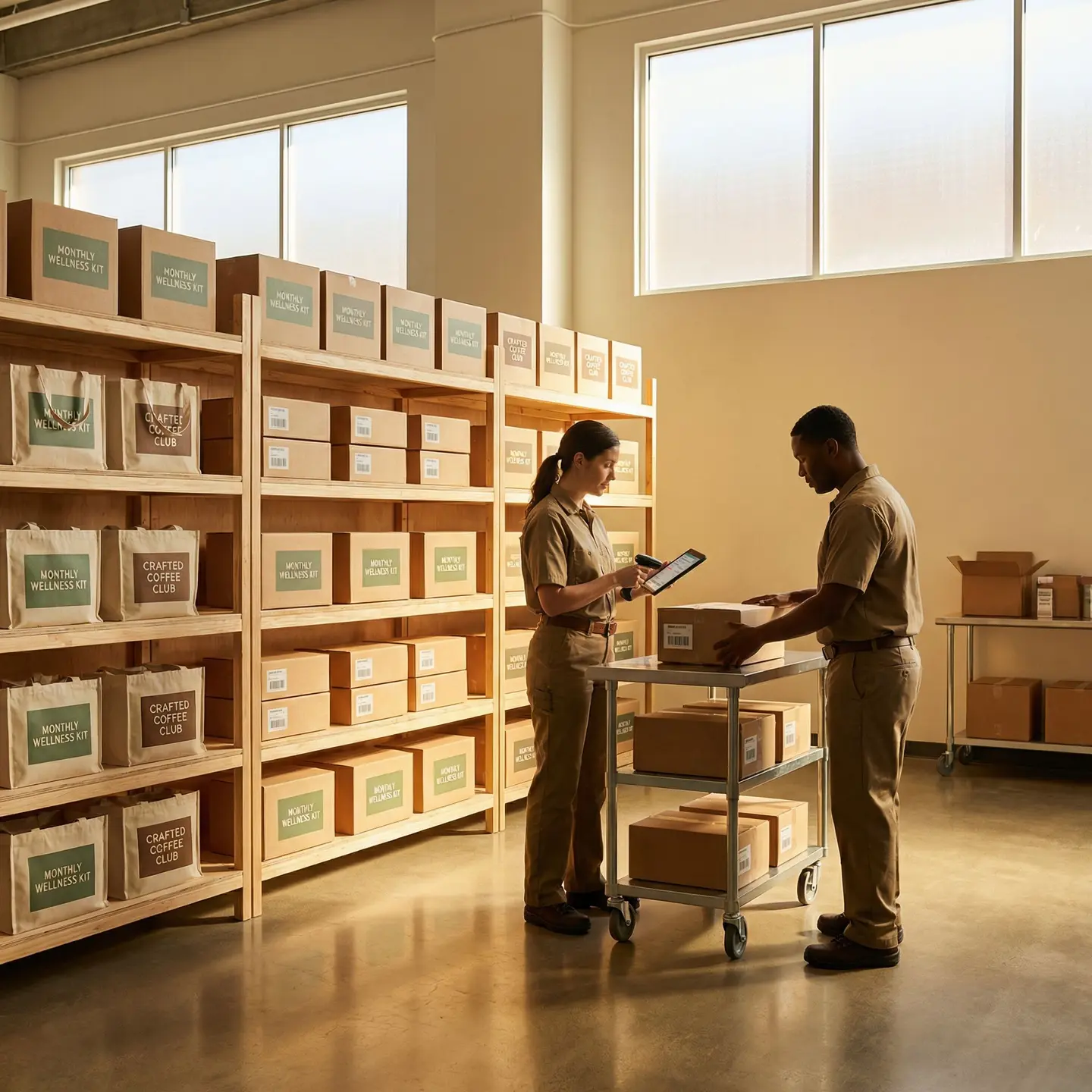
The unboxing experience is part of the subscription product itself. The anticipation, the surprise, the “birthday present” feeling that drives social media sharing and subscriber retention—all depend on fulfillment execution that treats presentation as seriously as accuracy. This means packing is not merely functional. Branded tissue, crinkle fill, deliberate product arrangement, printed inserts, and premium packaging materials become standard operating requirements rather than optional upgrades.
Inventory Forecasting Complexity
Subscription businesses must forecast not only new subscriber acquisition but also churn, subscription pauses, plan downgrades, and seasonal skip rates. Over-ordering ties up capital in inventory that may become obsolete when product rotations occur. Under-ordering causes stockouts that result in missed shipments and subscriber dissatisfaction. Our real-time inventory systems help subscription brands maintain visibility into stock levels and trigger reorder alerts before problems develop.
Scaling Without Breaking Quality
A subscription shipping 200 boxes in month one and 2,000 by month six needs fulfillment infrastructure capable of absorbing that growth without accuracy degradation or presentation quality decline. Many subscription brands discover that their fulfillment partner performs adequately at low volume but fails catastrophically when volume spikes during promotional periods or viral moments.
How Subscription Box Fulfillment Works with a 3PL
When working with a specialized eCommerce fulfillment partner, the subscription fulfillment process follows a structured workflow designed to maintain accuracy and presentation quality at scale.
Step-by-Step Subscription Fulfillment Process
- Inventory Receiving and Stowing: Products arrive at the fulfillment center, are counted against purchase orders, inspected for damage or discrepancies, and placed in designated storage locations optimized for picking efficiency.
- Order Data Integration: Subscription orders flow automatically from the brand’s eCommerce platform or subscription management tool—Shopify, Cratejoy, ReCharge, Bold Subscriptions, WooCommerce—into the fulfillment center’s warehouse management system. Our eCommerce integrations ensure seamless data flow without manual intervention.
- Kitting and Assembly: Products are picked according to subscription tier specifications and assembled into the designated configuration. This includes branded packaging, tissue paper, promotional inserts, samples, and any personalization elements the brand requires.
- Quality Control: Assembled boxes are verified against the order specification before sealing. Scan verification systems confirm that every item matches the manifest, and visual inspection confirms presentation standards.
- Shipping and Carrier Selection: Our carrier rate shopping technology automatically compares rates across FedEx, UPS, Canada Post, Canpar, GLS, and UniUni to identify the optimal combination of speed and cost for each shipment.
- Tracking and Notification: Tracking information syncs back to the brand’s platform and the customer automatically, triggering shipment confirmation emails without manual data entry.
- Returns and Exchanges: Our reverse logistics capabilities manage returns, redirections, and damaged shipment replacements so brands do not touch any part of the returns process.
When to Outsource Subscription Box Fulfillment
We believe in honest guidance rather than pushing outsourcing on brands that are not ready. The decision to outsource should align with operational reality, not arbitrary growth milestones.
Outsourcing Makes Sense When:
- You are shipping 100 or more boxes monthly and the assembly and shipping workload is consuming time better spent on marketing, product development, and subscriber acquisition
- Your subscription uses standardized box configurations or replenishment-based product delivery
- You are scaling quickly and cannot hire, train, and manage warehouse staff fast enough to maintain quality
- You are expanding into new markets—particularly Canada—and need local fulfillment infrastructure to optimize delivery speed and cost
- You want to convert fixed warehouse costs into variable per-order costs that scale with revenue
Consider Staying In-House When:
- Your subscription involves extreme customization with handwritten notes, individual product selection based on subscriber preferences, or artisanal assembly requiring personal oversight
- Volume remains under 100 boxes monthly and the economics of outsourcing do not yet justify the transition
- You are still iterating on product format and box configuration and need full control to test quickly without coordinating with a third party
This honesty reflects our experience. We have worked with subscription brands that thrived after outsourcing and others that rightfully chose to maintain in-house operations because their product required personal attention we could not replicate.
How to Choose the Right Subscription Box Fulfillment Partner
Partner selection determines whether outsourcing accelerates growth or creates operational problems worse than in-house fulfillment. Evaluate potential partners across these critical capabilities:
Essential Evaluation Criteria
- Kitting and Assembly Capability: Can the partner handle complex multi-item assembly, branded inserts, custom packaging configurations, and rotating product mixes that change monthly?
- Custom Packaging Support: Do they work with branded boxes, tissue paper, crinkle fill, ribbon, and premium presentation materials—or only generic brown shipping cartons?
- Platform Integrations: Direct integration with your eCommerce platform and subscription management tools eliminates manual data entry and prevents order delays.
- Carrier Rate Shopping: Automated comparison across multiple carriers captures shipping cost savings impossible with single-carrier relationships.
- Inventory Visibility: Real-time stock levels, low-stock alerts, and demand forecasting support prevent stockouts that derail subscriber shipments.
- Scalability: Can the partner absorb three-to-five-times volume spikes during promotional periods, holiday seasons, or viral moments without accuracy degradation?
- Returns Handling: Full returns management including exchanges, damaged shipment replacements, and inventory inspection keeps brands focused on growth rather than operational firefighting.
- Geographic Positioning: For brands selling into Canada, fulfillment center locations directly impact delivery speed and shipping cost to Canadian subscribers.
Understanding Subscription Box Fulfillment Costs
Fulfillment costs for subscription boxes include several distinct components that brands must understand when evaluating outsourcing economics:
- Receiving Fees: Charged per unit or per shipment when inventory arrives at the fulfillment center
- Storage Fees: Monthly charges based on pallet, shelf, or bin space occupied by subscription inventory
- Pick and Pack / Kitting Fees: Per-box assembly charges that vary based on complexity, number of SKUs, and presentation requirements
- Packaging Materials: Branded boxes, tissue, inserts, and fill materials typically charged at cost or with modest markup
- Shipping Costs: Variable based on carrier selection, package weight and dimensions, and destination zone
- Returns Processing Fees: Per-return charges for receiving, inspecting, and restocking returned merchandise
Costs vary significantly based on box complexity, monthly volume, and shipping destinations. Basic subscription fulfillment typically costs $3.50 to $8.00 per box for straightforward configurations, though complex kitting with branded packaging and multiple SKUs can push costs meaningfully higher. We recommend requesting detailed quotes based on your specific box configuration rather than relying on industry averages.
Why Canadian-Based Fulfillment Matters for Subscription Brands
None of the major subscription fulfillment guides address the Canadian market—a significant gap given the scale of Canadian eCommerce and the specific challenges of cross-border fulfillment. This is where we differentiate.
Ottawa Logistics Subscription Fulfillment Capabilities
We operate fulfillment centers in Ottawa, Toronto, and Vancouver, providing coast-to-coast Canadian delivery optimization. Our D2C fulfillment operations process 40,000+ orders weekly with same-day fulfillment for orders received by 1:00 PM EST.
Key capabilities for subscription brands include:
- Multi-Carrier Rate Shopping: Automated comparison across FedEx, UPS, Canada Post, Canpar, GLS, and UniUni identifies the lowest rate per shipment
- Full Platform Integration: Direct connections with Shopify, Amazon, WooCommerce, NetSuite, and major ERP systems
- Regulatory Compliance: Licensed handling for health and beauty, food and beverage, and nutraceutical products requiring compliance documentation
- Complete Kitting Services: From simple two-item bundles to complex curated boxes with branded materials, inserts, and custom packaging
- Bilingual Support: English and French customer service covering the full Canadian market
Cross-Border Implications
The end of U.S. Section 321 de minimis treatment on August 29, 2025 fundamentally changed cross-border subscription economics. Brands previously shipping subscription boxes from U.S. fulfillment centers to Canadian subscribers duty-free now face per-shipment duties that erode margin and complicate customer pricing. Canadian-based fulfillment eliminates these duties for domestic Canadian subscribers while our Section 321 expertise helps brands navigate the evolving regulatory environment for U.S.-bound shipments.
Market Context and Growth Trajectory
The subscription box market continues rapid expansion despite economic uncertainty. The global subscription box market was valued at approximately $37.5 billion in 2024 according to IMARC Group, with projections indicating 13.3 percent compound annual growth through 2033. North America represents the largest regional market, with the United States accounting for approximately 85.5 percent of regional subscription box revenue at roughly $8.1 billion in 2024.
Food and beverage represents the largest subscription category at approximately 30 percent of the global market, followed by beauty and personal care. Personalized and curated boxes dominated with $11.6 billion in revenue in 2024, reflecting consumer preference for discovery-oriented subscriptions over simple replenishment models.
This growth trajectory means subscription brands face increasing competition for fulfillment capacity, particularly during peak seasons. Establishing relationships with capable fulfillment partners before volume demands exceed capacity is a strategic advantage that protects subscriber experience during growth phases.
Getting Started with Subscription Box Fulfillment
Transitioning subscription fulfillment to a 3PL partner requires structured planning to prevent subscriber disruption. The typical onboarding timeline spans four to six weeks, covering system integration testing, pilot shipments to verify presentation quality, and phased rollout with performance monitoring. We coordinate the transition to prevent any gap in subscriber deliveries during the switch.
We evaluate each subscription brand’s current operations, order volume, box complexity, and growth plans to build customized fulfillment proposals that address specific operational requirements. Whether you are outgrowing in-house fulfillment, launching a new subscription product line, or evaluating whether your current 3PL can handle recurring fulfillment demands, we provide transparent assessment of fit and capability.
Contact our team to request a free fulfillment assessment. We will analyze your subscription model, volume projections, and presentation requirements to determine whether partnership makes operational and economic sense for your brand’s growth trajectory.
Frequently Asked Questions
The end of U.S. Section 321 de minimis exemptions in August 2025 introduced per-shipment duties for cross-border subscription deliveries to Canadian customers. Fulfilling from Canadian centers in Ottawa, Toronto, and Vancouver eliminates those duties, speeds domestic delivery, and enables carrier rate optimization across Canada Post, FedEx, UPS, and regional carriers.
Curated boxes rotate products monthly, require sophisticated kitting with branded tissue, inserts, and deliberate product arrangement, and depend on unboxing presentation quality to drive retention and social sharing. Replenishment subscriptions ship the same items on a recurring schedule with minimal assembly variation.
Outsourcing typically makes sense once you are shipping 100 or more boxes monthly, scaling faster than you can hire and train warehouse staff, or expanding into new markets like Canada. It converts fixed warehouse costs to variable per-order fees and frees your team to focus on marketing, product development, and subscriber acquisition.
Subscribers expect consistent delivery timing and a curated unboxing experience with deliberate product arrangement and branded packaging. Delays or inconsistent presentation erode trust and accelerate cancellations at rates significantly higher than in standard ecommerce, where occasional shipping issues are more easily forgiven.
Core cost components include receiving, storage, kitting and assembly, packaging materials, shipping, and returns processing fees. Basic configurations typically run $3.50 to $8.00 per box, with complex kitting commanding higher fees. Control costs by negotiating multi-carrier rate shopping, right-sizing packaging, and using real-time inventory visibility to prevent stockouts and overstock.

Scale Your Canada Fulfillment with Confidence.
Partner with Canada's premier 3PL to unlock faster shipping, lower costs, and seamless scalability for your ecommerce brand.
Talk to an Expert