Shipping
Freight Consolidation Services: Reducing Shipping Costs Through Strategic Load Optimization

Shipping costs represent one of the most significant controllable expenses in eCommerce fulfillment, yet many brands approach freight decisions reactively rather than strategically. For operations managers and supply chain directors evaluating how to reduce per-unit transportation costs—particularly when expanding into the Canadian market—freight consolidation offers a mathematically sound path to measurable savings. At Ottawa Logistics Fulfillment, we work with brands processing hundreds of thousands of shipments annually, and we consistently see consolidation strategy separate cost-efficient operations from those bleeding margin on every order. This article breaks down the economic mechanics of freight consolidation, explains how consolidation centers actually operate, and provides a practical framework for calculating when consolidation delivers net savings versus when direct shipping makes more sense for your specific volume and timing requirements.

Who This Article Is For—And Who It Is Not
This content serves operations managers and supply chain directors at established eCommerce brands who need to evaluate freight consolidation fundamentals as a strategic cost-reduction mechanism. Specifically, it targets:
- US and international brands shipping into Canada who want to understand cross-border consolidation economics
- D2C operations processing 500+ monthly orders seeking to optimize inbound freight costs
- Supply chain teams evaluating whether consolidation timing tradeoffs align with their inventory velocity and customer expectations
This article is not for brands shipping fewer than 100 orders monthly, marketplace-only Amazon sellers without independent fulfillment needs, or operations requiring express delivery windows incompatible with consolidation dwell times. If your business demands next-day delivery on every shipment regardless of cost, consolidation economics will not align with your operational model.
Freight Consolidation Fundamentals: The Economic Principle
Freight consolidation is the strategic combination of multiple shipments to share transportation capacity—and by extension, share transportation costs. The core economic principle is straightforward: fixed transportation costs divided across more units reduces per-unit cost.
Consider the fundamental cost structure. A full container moving from a US port to Vancouver costs a fixed amount whether it carries one shipper’s goods or ten shippers’ goods. When that fixed cost is split among multiple shippers, each pays a fraction of what they would pay for dedicated capacity. The same logic applies to ground freight: a full truckload from Chicago to Toronto has a base rate regardless of whether the trailer contains one brand’s inventory or aggregated shipments from several brands.
This is distinct from simple multi-stop routing. Consolidation specifically refers to aggregating freight at a consolidation point, building full loads from partial shipments, and then moving those loads as complete units before deconsolidating at destination. The economic advantage comes from converting what would be multiple less-than-container-load (LCL) or less-than-truckload (LTL) shipments into full-capacity movements at lower per-unit rates.
Why Shared Capacity Creates Measurable Savings
The mathematics of consolidation benefits and operational considerations become clearer with a simplified example. Suppose a full truckload from Buffalo to Toronto costs $2,400. A brand shipping only 40% of a trailer’s capacity would typically pay LTL rates—often $1,600-$1,800 for that partial load due to carrier minimum charges and handling fees. However, if that brand’s freight consolidates with another shipper’s 40% and a third shipper’s 20%, the full $2,400 cost splits proportionally: roughly $960, $960, and $480 respectively. Each shipper pays substantially less than they would for individual LTL shipments.
This illustrates the consolidation value proposition: brands that cannot fill complete containers or trailers gain access to full-load economics by sharing capacity with other shippers moving freight on the same lanes.
LCL Ocean Freight Consolidation: How It Works
For brands importing goods from overseas manufacturers, less-than-container-load ocean freight consolidation provides significant cost advantages over booking individual LCL space at retail rates.
The process follows a defined sequence:
- Collection: A freight forwarder collects multiple LCL shipments bound for the same destination region
- Consolidation at origin: Shipments aggregate at an origin-port consolidation facility
- Full container movement: The consolidated freight ships as a full container load (FCL), securing lower per-cubic-meter rates
- Deconsolidation at destination: At the destination port, the container is unpacked and shipments separate for final delivery to individual consignees
The cost advantage derives from the rate differential between individual LCL bookings and shared FCL economics. However, timing is a critical variable. Consolidation requires waiting until sufficient volume accumulates to justify dispatch—which introduces dwell time at the consolidation center that directly affects transit timelines.
LTL Ground Freight Consolidation for Cross-Border Movement
For US brands shipping into Canada, ground freight consolidation at border-adjacent facilities creates particularly compelling economics. Hub-and-spoke models aggregate LTL freight from multiple origins, build full truckloads by Canadian destination zone, and dispatch consolidated loads that cross the border as single customs entries.
This approach delivers two distinct advantages:
- Transportation cost reduction: Per-unit freight costs decrease as partial loads combine into full truckloads
- Customs efficiency: One consolidated customs entry versus multiple individual entries reduces brokerage fees and administrative overhead
For brands shipping frequent small batches into Canada, consolidation transforms what would be expensive, repetitive LTL shipments into cost-efficient full truckload economics. This is particularly valuable for brands testing Canadian market demand without committing to large inventory positions.
Inside a Consolidation Center: Operational Mechanics
Understanding how consolidation facilities actually operate helps explain why timing variability exists and how to plan around it. Consolidation centers are not passive storage—they are active aggregation and routing hubs with specific operational sequences.

Receiving and Sortation
Inbound freight arrives from multiple shippers, often at different times and from different origins. Each shipment undergoes receiving verification, including piece count confirmation, dimension measurement, and destination coding. Freight then moves to sortation areas where shipments group by final destination zone.
Staging and Dwell Time Management
This is where the timing tradeoff becomes tangible. Freight waits in staging areas until sufficient volume accumulates to justify consolidated dispatch. For high-density lanes (like Buffalo-Toronto), accumulation may take only 1-2 days. For lower-volume lanes, dwell time may extend to 3-5 days while the consolidator waits for enough freight to build an efficient load.
Load Building and Cube Optimization
Consolidation center staff build loads to maximize cube utilization—the percentage of available trailer or container space actually filled with freight. Professional load building considers not just volume but weight distribution, stacking compatibility, and unloading sequence at destination. Technology systems track inbound shipments, calculate optimal consolidation windows based on historical lane density, and coordinate carrier pickup schedules.
Dispatch Coordination
Once a load reaches the threshold for dispatch—either full capacity or a predetermined consolidation window—the shipment moves to the carrier. The consolidator coordinates pickup timing, provides consolidated documentation for customs clearance (in cross-border scenarios), and transmits tracking information back to individual shippers.
Timing Tradeoffs: The Speed Penalty of Consolidation
Consolidation is not free—it costs time. Understanding the timing tradeoff is essential for determining whether consolidation aligns with your operational requirements.
Consider a comparative scenario for US-to-Canada ground freight:
- Direct LTL shipping: Pickup in Chicago, cross-border, delivery in Toronto = approximately 3-4 business days
- Consolidated freight: Pickup in Chicago, dwell at consolidation center (2-3 days), cross-border, delivery in Toronto = approximately 5-7 business days
The consolidation approach adds 2-3 days of dwell time while freight waits for volume accumulation. This is the fundamental tradeoff: pay more for speed, or accept delay for cost savings.
The strategic question becomes: what is that time worth? For brands with flexible inventory positions and customers who accept standard delivery windows, the timing penalty may be irrelevant. For brands with tight inventory turns or premium delivery commitments, consolidation dwell time creates costs that may exceed freight savings.
Break-Even Analysis: Calculating When Consolidation Saves Money
The most valuable tool for evaluating consolidation strategy is a break-even analysis that quantifies when consolidation cost savings exceed the carrying cost of delayed inventory.
Key Variables
- Direct LTL/LCL rate: What you would pay for direct shipping without consolidation
- Consolidated rate per unit: Your per-unit cost when freight consolidates
- Consolidation dwell time: Additional days freight sits at the consolidation center
- Inventory carrying cost: The daily cost of capital tied up in inventory during dwell
- Shipment frequency: How often you ship
- Volume per shipment: Units moved per shipment
Simplified Break-Even Formula
Net Consolidation Savings = (Direct Shipping Cost – Consolidated Shipping Cost) – (Daily Inventory Carrying Cost × Dwell Days × Units)
If Net Consolidation Savings > 0, consolidation is financially advantageous. If Net Consolidation Savings < 0, direct shipping makes more sense despite higher freight rates.
Example Scenario
A US nutraceutical brand ships 500 units monthly into Canada:
- Direct LTL cost: $1,800 per shipment
- Consolidated cost: $1,200 per shipment
- Freight savings: $600
- Consolidation dwell time: 3 days
- Product cost per unit: $40
- Annual carrying cost rate: 25%
- Daily carrying cost per unit: $40 × 0.25 ÷ 365 = $0.027
- Total carrying cost during dwell: $0.027 × 3 days × 500 units = $40.50
Net Savings: $600 – $40.50 = $559.50 per shipment
In this scenario, consolidation clearly wins. The freight savings far exceed the inventory carrying cost of the 3-day dwell period.
However, consider a different scenario—a brand shipping high-value electronics at $500 per unit with the same parameters. The carrying cost during dwell becomes $102.74, still well below the $600 freight savings. But for time-sensitive products with customers expecting 2-day delivery, the 3-day dwell may create service failures that cost more than any freight savings.
This framework helps you calculate the financial break-even. The operational break-even requires additional consideration of customer expectations, competitive delivery timelines, and inventory management complexity.
Cross-Border US-to-Canada Consolidation Strategy
For US-based brands entering the Canadian market, consolidation serves not just as a cost-reduction tactic but as a strategic enabler for cost-sensitive market expansion.
Consider the challenge: a US D2C brand wants to serve Canadian customers but lacks the volume to justify FTL shipments or immediate investment in dedicated Canadian inventory. Without consolidation, the brand faces two unappealing options:
- Ship individual orders cross-border: High per-order shipping costs, customs complexity on every shipment, and unpredictable delivery timelines
- Commit to large inventory shipments: Capital-intensive, risky if Canadian demand is unproven
Consolidation creates a third path. The brand ships smaller, more frequent replenishments to a consolidation point, where their freight combines with other Canada-bound shipments. The consolidated load crosses the border as a single customs entry, reducing brokerage fees. At the Canadian destination, freight deconsolidates and moves to a fulfillment facility for domestic order processing.
This approach enables brands to test product-market fit before scaling to dedicated US-to-Canada cross-border shipping solutions infrastructure. Lower upfront freight investment, faster inventory turns, and the ability to adjust volume based on actual demand rather than forecasted demand—all while maintaining near-FTL per-unit economics.
Deconsolidation and Final Delivery Coordination
The destination-side process is equally important to understand. Consolidated freight arriving in Canada must be separated and routed to final recipients—whether that means delivery to a fulfillment center, distribution to retail locations, or coordination with last-mile carriers.
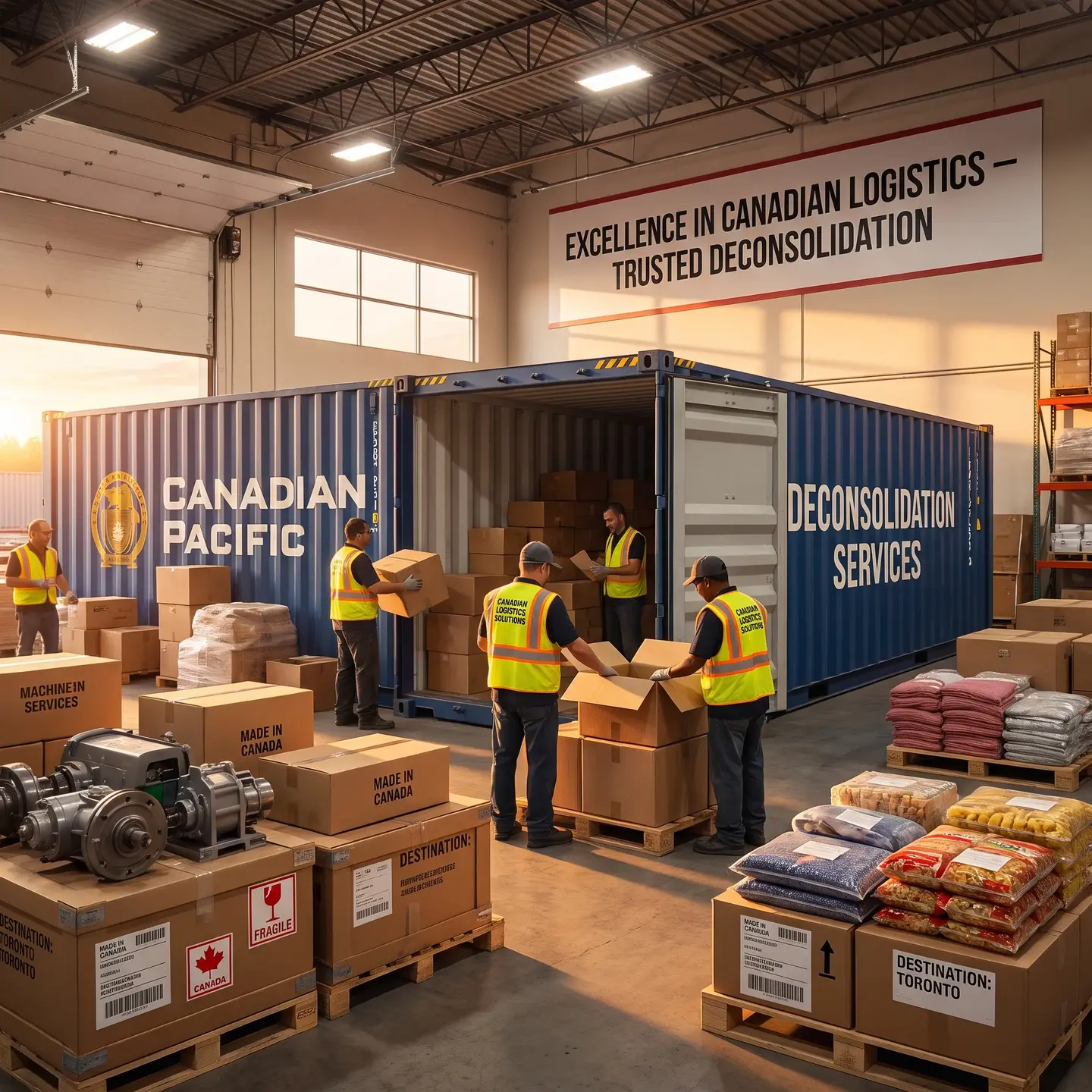
Deconsolidation centers receive full containers or truckloads and execute a reverse of the consolidation process:
- Unload consolidated freight
- Sort by final consignee or destination zone
- Stage for pickup or coordinate outbound carriers
- Transmit tracking updates to individual shippers
For brands using cross-docking and freight consolidation strategies, the deconsolidation point often serves as the handoff to fulfillment operations. Freight arrives consolidated, deconsolidates into individual brand inventory, and immediately integrates with fulfillment systems for customer order processing.
This is where the choice of Canadian partner becomes critical. Accurate labeling throughout the consolidation-deconsolidation cycle, seamless tracking handoffs, and coordination with final-mile delivery partners determine whether consolidation savings survive contact with operational reality.
When Consolidation Makes Strategic Sense
Based on the economics and operational mechanics outlined above, consolidation delivers maximum value in specific scenarios:
Strong Consolidation Fit
- High-volume, lower-margin products where per-unit freight cost directly impacts profitability
- Flexible delivery windows where customers accept standard shipping timelines
- Predictable demand patterns that allow scheduling consolidated shipments around inventory cycles
- Market testing scenarios where brands want to limit capital at risk while proving Canadian demand
- Products with extended shelf life where 3-5 additional days in transit creates no quality concerns
Weak Consolidation Fit
- Time-sensitive products where customers expect 1-2 day delivery
- High-value, low-volume products where inventory carrying costs during dwell may exceed freight savings
- Highly variable demand where consolidation scheduling complexity creates operational burden
- Products requiring temperature control or specialized handling that limits consolidation compatibility
Consolidation as Canadian Market Entry Strategy
For brands evaluating freight forwarding services into Canada, consolidation represents more than cost reduction—it represents risk mitigation for market expansion.
The traditional approach to Canadian market entry requires significant upfront investment: large inventory shipments, customs infrastructure, and fulfillment partnerships sized for anticipated volume. If demand fails to materialize, brands face write-offs, stranded inventory, and sunk partnership costs.
Consolidation-based market entry inverts this model. Brands ship smaller replenishments, pay near-FTL rates through shared capacity, and scale volume based on actual sales rather than forecasted demand. The financial barrier to testing Canadian customers drops substantially, and the ability to adjust—increasing frequency when products sell, reducing when they don’t—provides operational flexibility that dedicated-capacity models cannot match.
This is particularly relevant for brands in regulated categories like natural health products, food, and cosmetics. Compliance requirements for Canadian sales add complexity to any market entry. Using consolidation to test demand before committing to full-scale Canadian inventory allows brands to validate both market acceptance and Canadian customs compliance workflows with limited downside exposure.
Partnering for Consolidation Success
Effective consolidation strategy requires more than understanding the economics—it requires operational execution by partners who specialize in aggregating freight, managing customs efficiently, and coordinating deconsolidation with fulfillment.
At Ottawa Logistics Fulfillment, we serve as the Canadian deconsolidation and fulfillment partner for brands using cross-border consolidation strategies. Our facilities in Ottawa, Toronto, and Vancouver receive consolidated freight, integrate inventory into our warehouse management systems, and execute same-day fulfillment for orders received by 1:30 PM EST. For US brands entering the Canadian market, this means consolidated inbound freight translates directly to domestic Canadian shipping rates and delivery speeds for their customers.
The combination of Freight Forwarding expertise, cross-border compliance experience, and distributed Canadian fulfillment infrastructure positions us to help brands capture consolidation savings without sacrificing service quality. Whether you are calculating your own break-even point or ready to implement consolidation-based Canadian market entry, we provide the operational foundation that makes the strategy work.
Frequently Asked Questions
The core tradeoff is simple: you pay more for speed with direct LTL/LCL shipping, or you accept a 2–3 day delay for lower per-unit freight costs with consolidation. If your inventory turns and customer expectations can absorb those extra days of dwell time at a consolidation center, consolidation usually wins on cost.
Instead of shipping large, risky inventory loads into Canada or paying high per-order cross-border costs, you send smaller, frequent replenishments to a consolidation point. Your freight is combined with other Canada-bound shipments, crosses the border as a single customs entry, and then deconsolidates into a Canadian fulfillment center—letting you test demand and compliance with lower upfront investment.
Freight consolidation makes sense if you ship at least around 500 orders a month, have flexible delivery windows, and your customers are comfortable with standard (not express) shipping timelines. It’s especially helpful if you’re moving high-volume, lower-margin products where every cent of per-unit freight cost impacts profitability.
Start by comparing your direct LTL/LCL cost to your consolidated cost per shipment, then subtract the inventory carrying cost of added dwell days. If (Direct Shipping Cost − Consolidated Shipping Cost) is still greater than your total carrying cost for those extra days, consolidation is financially advantageous for that lane and volume.
Consolidation is a poor fit if you ship fewer than about 100 orders a month, rely on next-day or 1–2 day delivery promises, or sell time-sensitive or specialized products (like temperature-controlled goods) where added dwell time or mixed loads introduce risk that outweighs the freight savings.

Scale Your Canada Fulfillment with Confidence.
Partner with Canada's premier 3PL to unlock faster shipping, lower costs, and seamless scalability for your ecommerce brand.
Talk to an Expert