Fulfillment
LTL vs. FTL Shipping: Choosing the Right Freight Mode for Your Inventory Needs

Freight mode selection sits at the intersection of cost management, inventory velocity, and fulfillment performance—making it one of the most consequential operational decisions for ecommerce brands managing Canadian market expansion. When we work with brands navigating cross-border fulfillment into Canada, the question of whether to use less-than-truckload (LTL) or full truckload (FTL) shipping rarely has a simple answer. The optimal choice depends on shipment frequency, SKU velocity, seasonal patterns, and—critically—how inbound freight timing affects your ability to maintain fulfillment commitments to Canadian customers. This guide moves beyond basic weight thresholds to provide a decision framework that connects freight mode selection to the operational realities of distributed fulfillment across Ottawa, Toronto, and Vancouver.
Who This Guide Is For—And Who It Isn’t

This article is designed for operations managers and supply chain directors at established D2C ecommerce brands processing 500+ orders monthly who are evaluating freight strategies for moving inventory into Canadian fulfillment operations. If you’re managing inbound logistics for health, beauty, food, or natural health product brands requiring cross-border compliance, or if you’re a US brand establishing Canadian fulfillment presence to eliminate cross-border friction for your customers, this framework applies directly to your situation.
This guide is not intended for:
- Startups shipping fewer than 100 orders monthly who haven’t reached the volume thresholds where freight mode optimization becomes material
- Marketplace-only Amazon sellers whose inbound logistics are dictated by FBA requirements
- Brands seeking basic definitions of LTL versus FTL rather than operational decision criteria
If you’re evaluating how to position inventory within Canada for domestic shipping rates and delivery speeds, the freight mode decisions outlined here directly affect your fulfillment economics and service level capabilities.
LTL and FTL Fundamentals: Beyond Basic Definitions
Understanding the operational mechanics of each freight mode—not just the textbook definitions—determines how effectively you can plan warehouse receiving, labor allocation, and inventory availability timing.
How LTL Consolidation Actually Works
LTL shipping involves shared trailer space where your freight travels alongside shipments from multiple shippers. Your pallets move through a hub-and-spoke network: picked up from the origin, transported to a regional terminal, consolidated with other freight heading in the same direction, potentially cross-docked through additional terminals, then delivered to the final destination. Each consolidation point introduces a handling event and extends transit time variability.
For fulfillment operations, this means:
- Broader pickup windows (often 4-8 hour ranges rather than specific appointments)
- Delivery date estimates rather than firm delivery appointments
- Multiple handling events that affect damage risk for fragile or regulated products
- Less predictable receiving schedules at your Canadian fulfillment center
FTL Dedicated Capacity Mechanics
FTL shipping dedicates the entire trailer to your shipment. Your freight is loaded at origin, sealed, and transported directly to destination without intermediate handling or consolidation. The trailer remains sealed throughout transit, providing a single chain of custody.
Operationally, FTL enables:
- Firm pickup and delivery appointments that support precise labor scheduling
- Direct routing that eliminates consolidation delays
- Minimal handling exposure—typically just origin loading and destination unloading
- Predictable receiving timing that improves put-away efficiency and inventory availability
When we schedule FTL deliveries at our facilities, we can align receiving labor with known arrival times, process inventory immediately upon arrival, and update available stock within hours rather than days.
Cost Structure Analysis: Understanding Total Landed Cost
The common assertion that “LTL is cheaper for small shipments” oversimplifies freight economics. True cost comparison requires examining total landed cost—including handling labor, storage costs while awaiting full loads, and opportunity costs of delayed inventory availability.
LTL Pricing Components
LTL rates are built from multiple variables:
- Freight class: Based on density, stowability, handling requirements, and liability
- Weight and dimensions: Actual weight versus dimensional weight calculations
- Accessorial charges: Liftgate, inside delivery, residential delivery, limited access fees
- Fuel surcharges: Variable percentage applied to base rates
- Distance: Origin-destination mileage bands
For cross-border freight moving into Canadian fulfillment operations, LTL pricing also reflects customs clearance timing and potential storage fees if shipments are held pending documentation.
FTL Pricing Components
FTL pricing operates on different principles:
- Per-mile rates: Base cost calculated on origin-destination distance
- Dedicated capacity: You pay for the trailer whether it’s full or partially loaded
- Detention fees: Charges for loading/unloading time beyond standard windows
- Fuel surcharges: Applied to mileage-based rates
The Hidden Costs That Change the Equation
Beyond line-haul rates, consider these cost factors:
Inventory holding costs while awaiting consolidation: If you’re accumulating inventory to build FTL-worthy volumes, you’re paying storage at origin—and delaying when that inventory becomes available for fulfillment.
Receiving labor efficiency: LTL’s unpredictable delivery windows make labor scheduling challenging. FTL’s appointment-based delivery enables precise staffing.
Safety stock requirements: Transit time variability in LTL necessitates higher safety stock levels to buffer against delivery uncertainty—increasing carrying costs.
Damage and claims processing: LTL’s multiple handling events increase damage probability. Claims processing consumes administrative resources beyond the direct loss value.
A nutraceutical brand shipping 12 pallets of fast-moving SKUs weekly from a US manufacturer to Canadian fulfillment operations faces different freight economics than a cosmetics company consolidating 3-4 pallets monthly for seasonal inventory builds. The first scenario likely favors FTL for its predictability and damage protection; the second may favor LTL unless handling risk for cosmetic products justifies the FTL premium.
Transit Time and Reliability: Beyond Delivery Speed
Transit time differences between LTL and FTL extend beyond simple day counts. The reliability dimension affects inventory planning, safety stock calculations, and your ability to maintain consistent fulfillment service levels.
LTL Transit Variability
LTL carriers provide estimated delivery windows rather than guaranteed appointments. A shipment quoted at 3-5 business days might arrive on day 3 or day 5—a 67% variance that cascades through your operations:
- Receiving staff scheduled for day 3 may sit idle if freight arrives day 5
- Inventory counts remain uncertain until physical receipt and put-away
- Safety stock buffers must accommodate the full variance range
- Promotional inventory positioning becomes less reliable
FTL Predictability Advantages
FTL’s appointment-based delivery enables operational precision:
- Receiving labor aligned to known arrival times
- Immediate put-away and inventory availability updates
- Tighter safety stock requirements due to reduced transit uncertainty
- Reliable promotional inventory positioning
This transit variability doesn’t just affect delivery dates—it determines your safety stock requirements and your ability to maintain two-day fulfillment commitments to Canadian customers.
Seasonal Volume Implications
During peak seasons, transit reliability differences amplify. LTL networks experience congestion at terminals, extending transit times and widening delivery windows. FTL capacity becomes scarcer but maintains routing predictability. Brands experiencing up to 340% volume fluctuations during peak periods need freight strategies that accommodate these swings without compromising fulfillment performance.
Volume Thresholds and Breakeven Analysis

The commonly cited “six-pallet rule” provides a starting point but oversimplifies the decision framework. According to truckload shipping best practices, LTL shipments typically range from 150 to 15,000 pounds and include up to 10 pallets, while FTL becomes more appropriate when freight exceeds 15,000 pounds and/or 10 pallets.
The Six-Pallet Threshold in Context
Six pallets represents a common inflection point where FTL often becomes cost-competitive with LTL, but the actual breakeven depends on:
- Freight class: Higher-class freight (lower density, higher handling requirements) reaches FTL breakeven at lower pallet counts
- Lane density: High-traffic lanes have more competitive FTL rates
- Shipment frequency: Regular shipments enable better FTL rate negotiation
- Accessorial requirements: Heavy accessorial charges on LTL shipments accelerate FTL breakeven
Volume Shipping: The Middle Option
Volume shipping—an LTL subset for loads of more than 6 pallets weighing between 8,000 and 10,000 pounds—offers a middle path. Volume rates provide better economics than standard LTL for larger shipments while avoiding FTL’s full-trailer commitment. This option works well for brands whose regular shipment volumes fall in the 6-10 pallet range.
Frequency-Based Decision Framework
Consider freight mode selection through the lens of replenishment cadence:
Daily replenishment: High-velocity operations benefit from consistent FTL lanes that enable predictable receiving schedules and inventory turns.
Weekly bulk shipments: The 6-10 pallet range often aligns with volume LTL or partial truckload strategies.
Monthly or seasonal inventory builds: Larger, less frequent shipments typically justify FTL, especially when inventory velocity supports the capital commitment.
When Handling Risk Justifies FTL Premium Costs
LTL’s hub-and-spoke model introduces multiple handling events: origin loading, terminal unloading, cross-dock sorting, reload for linehaul, potential additional terminal handling, and final delivery unloading. Each touchpoint presents damage opportunity.
Product Categories Requiring Handling Consideration
For regulated product categories—natural health products, food and beverage, cosmetics—handling damage extends beyond financial loss to compliance implications. A damaged product may require disposal, documentation, and potential regulatory notification. Freight shipping fundamentals for regulated products must account for these extended consequences.
Products warranting careful handling evaluation include:
- Glass-packaged cosmetics and serums: Breakage risk at each handling point
- Temperature-sensitive natural health products: Extended terminal dwell times may compromise stability
- Food products with packaging integrity requirements: Dented or damaged packaging may require rejection
- High-value inventory: Dollar risk per handling event may justify FTL protection
Packaging Versus Mode Decision
Enhanced packaging can mitigate some LTL handling risk, but packaging costs add to total landed cost. When packaging upgrades required for safe LTL transit approach the cost differential between LTL and FTL, dedicated capacity becomes economically rational.
Hybrid Freight Strategies: Combining Modes for Operational Efficiency
Sophisticated fulfillment operations rarely use a single freight mode exclusively. Hybrid strategies that segment inventory by velocity, margin, and handling requirements optimize freight spend while maintaining service levels.
SKU Velocity Segmentation
Segment your product catalog by movement velocity:
Fast-moving SKUs (A-items): High-velocity products that drive the majority of order volume often justify dedicated FTL lanes. Predictable replenishment enables rate negotiation and receiving efficiency.
Medium-velocity SKUs (B-items): Products with moderate movement may consolidate into volume LTL shipments, balancing cost efficiency with reasonable transit reliability.
Slow-moving SKUs (C-items): Low-velocity products that don’t justify dedicated freight capacity are appropriate for standard LTL, accepting longer transit in exchange for cost efficiency.
Seasonal Strategy Adaptation
Freight mode mix should flex with demand patterns:
- Pre-season builds: FTL for bulk inventory positioning ahead of peak periods
- Peak season replenishment: Maintaining FTL lanes for fast-movers while using LTL for assortment fill-in
- Post-peak rebalancing: LTL for return-to-normal inventory adjustments
Cross-Docking as a Mode Optimizer
Our cross-docking capabilities enable hybrid strategies that would otherwise be impractical. Inbound FTL shipments can be immediately sorted and redistributed to multiple destinations, while LTL receipts can be consolidated for efficient put-away.
Operational Integration: How Freight Mode Affects Fulfillment Performance
Freight decisions aren’t isolated transportation choices—they cascade through warehouse operations and ultimately affect your customers’ experience.
Receiving Capacity Planning
FTL’s appointment-based delivery enables precise receiving labor scheduling. When we know a 53-foot trailer arrives at 10:00 AM, we can staff appropriately, stage equipment, and clear dock space. LTL’s delivery windows require maintaining receiving capacity across broader timeframes or accepting potential delays when shipments arrive outside staffed hours.
Inventory Availability Timing
The interval between freight arrival and available-for-fulfillment status directly affects your ability to maintain inventory levels:
- FTL with scheduled receiving: Inventory available within hours of arrival
- LTL with variable delivery: Inventory availability depends on arrival timing relative to receiving staff availability
For brands committed to same-day fulfillment for orders received by 1:30 PM EST, inbound freight timing directly affects whether inventory is available to fulfill those orders.
Put-Away Efficiency
Consolidated FTL shipments enable batch put-away processes—moving like SKUs to storage locations in efficient workflows. Mixed LTL receipts may require sorting before put-away, adding labor and extending the receipt-to-available cycle.
Cross-Border Freight Considerations for Canadian Operations
International brands establishing Canadian fulfillment presence face freight mode decisions that affect customs clearance efficiency and inventory positioning strategy. Our US-to-Canada fulfillment solutions support brands navigating these complexities.
Customs Clearance Implications
Freight mode affects customs processing:
FTL shipments: Single customs entry for the entire trailer simplifies documentation and typically enables faster clearance.
LTL shipments: Consolidated loads may involve multiple customs entries, potentially extending clearance time if any shipper’s documentation is incomplete.
Compliance Documentation Management
For regulated products requiring Health Canada compliance—natural health products, food, cosmetics—freight mode affects documentation management. FTL’s single-shipper model maintains clear chain of custody and documentation alignment. LTL consolidation may complicate lot tracking and regulatory documentation.
Canadian Distribution Network Optimization
Brands positioning inventory across our Ottawa, Toronto, and Vancouver fulfillment centers can use freight mode strategically:
- FTL for primary inventory builds at each location
- LTL for inter-facility transfers and assortment rebalancing
- Local delivery for regional customers near each facility
Our Freight Forwarding and freight forwarding services coordinate these multi-modal strategies.
Decision Framework Summary
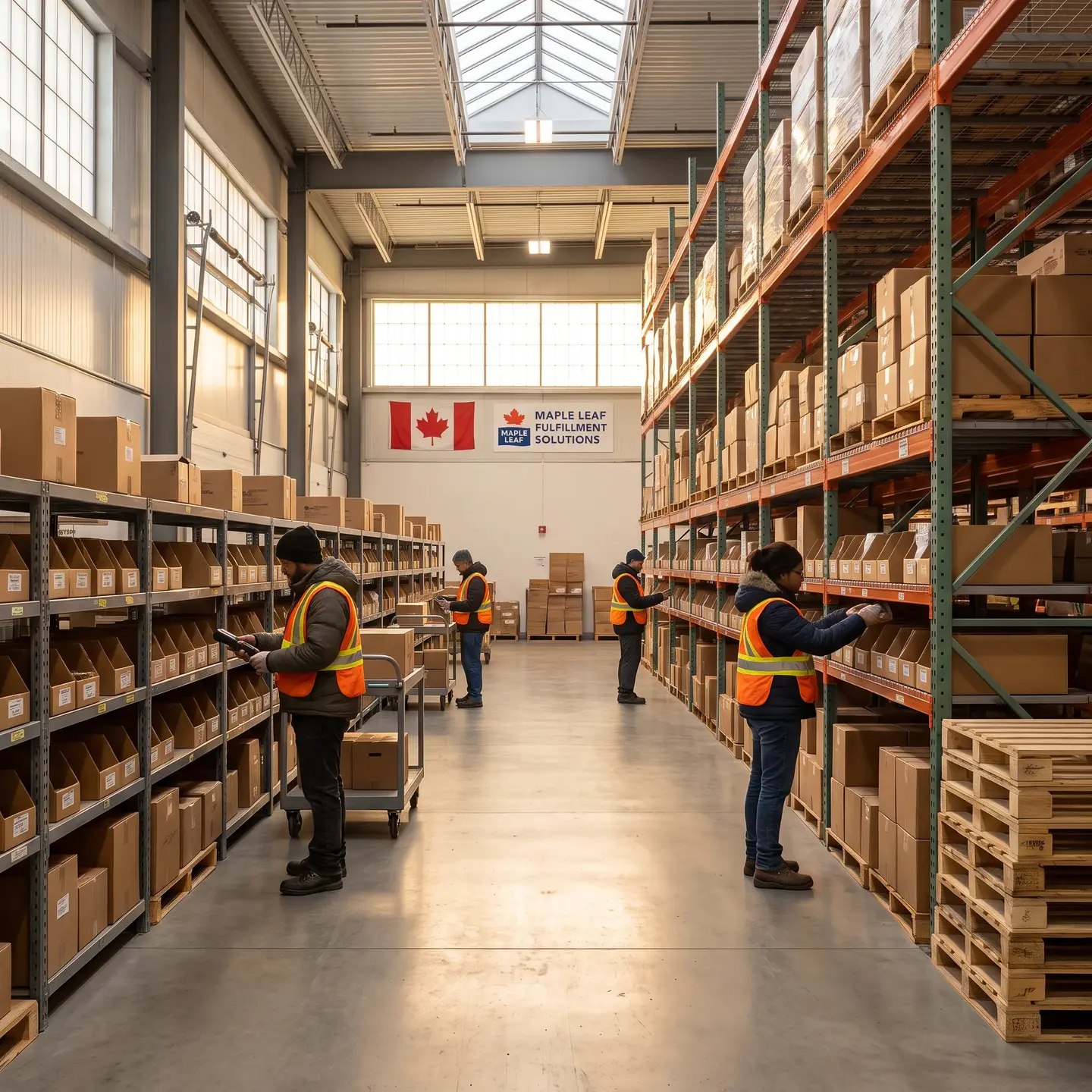
When evaluating LTL versus FTL for your Canadian fulfillment operations, consider these decision criteria:
Choose FTL when:
- Shipment volume exceeds 10 pallets or 15,000 pounds
- Transit time predictability directly affects fulfillment SLAs
- Product handling sensitivity justifies reduced touchpoints
- Receiving labor efficiency requires scheduled appointments
- Cross-border compliance documentation benefits from single-shipper simplicity
- Fast-moving SKUs require predictable replenishment cadence
Choose LTL when:
- Shipment volume falls in the 1-6 pallet range
- Transit time flexibility exists in your inventory planning
- Products tolerate multiple handling events without damage
- Cost efficiency takes priority over receiving predictability
- Slow-moving SKUs don’t justify dedicated capacity
- Market testing requires smaller, more frequent inventory movements
Consider hybrid strategies when:
- SKU velocity varies significantly across your catalog
- Seasonal demand patterns require flexible capacity
- Cross-border and domestic shipments have different requirements
- Multiple fulfillment locations require different replenishment cadences
The optimal freight mode selection emerges from understanding your specific operational context—shipment volumes, product characteristics, service level requirements, and fulfillment network design. We’ve worked with brands across the volume spectrum, from those building their first Canadian inventory position to operations processing 40,000+ weekly orders requiring sophisticated multi-modal freight strategies. The common thread is recognizing that freight mode decisions affect far more than transportation cost—they shape your ability to deliver consistent fulfillment performance for Canadian customers.
Frequently Asked Questions
LTL gives you shared trailer space but also broad pickup windows, estimated (not firm) delivery dates, more handling events, and less predictable receiving at your Canadian 3PL. FTL, with dedicated capacity and appointments, lets you tightly schedule labor, receive and put away quickly, and make inventory available within hours of arrival.
Yes—most mature operations use hybrid strategies. Fast-moving SKUs and pre-season builds often ride on FTL lanes; mid-velocity items fit volume LTL; slow movers and post-peak rebalancing typically go standard LTL. If you’re using multiple Canadian sites (Ottawa, Toronto, Vancouver), you can further mix modes for primary inbound, inter-facility transfers, and local delivery.
If you’re an established D2C brand doing 500+ orders a month and moving inventory into Canadian fulfillment (especially in health, beauty, food, or natural health), this guide is built for your operational reality. If you’re a very early-stage startup, Amazon-only, or just looking for basic definitions, it’s not the right fit.
If you’re shipping glass-packaged, temperature-sensitive, or high-value regulated products, the multiple touchpoints in LTL increase both damage and compliance risk. In many cases, paying the FTL premium or upgrading packaging becomes justified once you account for potential product loss, disposal, and regulatory documentation headaches.
FTL tends to become competitive when you’re consistently shipping around 6+ pallets, especially on high-density lanes, with regular frequency and meaningful accessorial charges on LTL. You also need to factor in hidden costs: inventory sitting at origin, extra safety stock, scheduling inefficiencies, and damage/claims administration.

Scale Your Canada Fulfillment with Confidence.
Partner with Canada's premier 3PL to unlock faster shipping, lower costs, and seamless scalability for your ecommerce brand.
Talk to an Expert