Shipping
Cross-Border Returns Management: Handling International Returns Without Destroying Margins
Consider this scenario: A US-based skincare brand expanding into Canada generates $50,000 in monthly Canadian revenue with a 15% return rate. If those returns ship back to their American warehouse at $25 per package, they’re losing $1,875 monthly on return shipping alone—before factoring in processing time, inventory write-offs, and customer service costs. That same brand, fulfilling from within Canada, pays roughly $8 per domestic return shipment, reducing that line item to $600. The $1,275 monthly savings represents pure margin recovery, and that’s just the shipping component.
This is the reality facing international brands serving Canadian customers: returns can quietly destroy profitability unless approached as a strategic supply chain decision rather than an operational afterthought. At Ottawa Logistics Fulfillment, we’ve spent over a century refining logistics operations, and we’ve watched brands learn this lesson the expensive way. The good news is that with proper planning and the right fulfillment infrastructure, cross-border returns management becomes a manageable cost center rather than a margin-eating force.

Who This Article Is For—And Who It Isn’t
This guide is written for operations managers, supply chain directors, and founders at D2C brands currently selling or planning to sell into Canada from the United States, United Kingdom, European Union, or Asia-Pacific markets. If you’re processing 500+ orders monthly, experiencing pain points with Canadian returns, or conducting due diligence before market expansion, you’ll find actionable frameworks here.
This article is not for brands shipping exclusively within their home market, startups under 100 orders monthly, or Amazon-only sellers whose returns are managed through marketplace programs. If you’re looking for guidance on outbound fulfillment processes, warehouse management systems, or demand forecasting, those topics are covered elsewhere in our resource library.
The International Returns Challenge: Why Complexity Multiplies Across Borders
Domestic returns operate within a single regulatory environment with predictable shipping costs and straightforward restocking procedures. A Canadian brand returning products to a Canadian warehouse faces minimal friction: consistent carrier rates, no customs considerations, and clear regulatory pathways for restocking inventory.
International brands serving Canadian customers face an entirely different equation:
- Geographic distance inflates return shipping costs, often making it economically irrational to bring products back to origin warehouses
- Regulatory divergence between home markets and Canada creates uncertainty about restocking eligibility, particularly for regulated products
- Extended processing timelines frustrate customers who expect rapid refunds
- Currency fluctuations can erode the value of returned inventory before it’s even processed
- Customs complexity on returned goods adds administrative burden and potential duty implications
The customer experience impact compounds these operational challenges. According to research from DHL, 59% of shoppers now purchase from retailers outside their home countries, with 35% doing so monthly. These cross-border consumers carry the same return expectations as domestic shoppers—expectations shaped by seamless experiences with local retailers. When an international brand’s return process feels cumbersome or expensive, customer lifetime value erodes rapidly.
The trust factor matters significantly here. Research indicates that 70% of shoppers will only purchase from countries they trust, with Canada ranking among the top trusted nations alongside the USA, UK, Germany, and Australia. International brands can leverage this trust, but only if their returns experience matches customer expectations formed by domestic Canadian retailers.
Return Shipping Economics: The Math That Destroys Margins
Let’s examine the actual cost structures that international brands face when managing Canadian returns without in-country fulfillment infrastructure.
The International Return Cost Breakdown
For a typical $50 product shipped from an American warehouse to a Canadian customer:
- International return shipping: $20-35 depending on weight and carrier
- Customs documentation and potential duties: $5-15 in administrative costs
- Extended processing time: 10-21 days versus 3-5 days for domestic returns
- Customer service touchpoints: 2-3 additional contacts during extended wait periods
- Inventory depreciation: Products lose value while sitting in transit and processing queues
Compare this to the same product fulfilled from within Canada:
- Domestic Canadian return shipping: $6-12 depending on zone and carrier
- No customs complexity: Zero additional administrative burden
- Standard processing time: 3-5 days from customer shipment to refund
- Minimal customer service escalation: Straightforward tracking and timelines
- Rapid inventory reintegration: Resalable products return to available stock quickly
The Free Returns Expectation
Canadian consumers increasingly expect free returns as a baseline offering. When international brands can’t economically provide this—because each return costs $25+ in shipping alone—they face a competitive disadvantage against Canadian retailers and brands with in-country fulfillment.
The numbers become stark at scale. A brand with 1,000 monthly Canadian orders and a 15% return rate processes 150 returns. At $25 per international return, that’s $3,750 monthly in return shipping. At $8 per domestic Canadian return, the cost drops to $1,200. Over a year, in-country fulfillment positioning saves $30,600 on return shipping alone—likely exceeding the cost differential of maintaining Canadian inventory.
The Write-Off Reality
Many international brands facing high return shipping costs simply write off Canadian returns entirely. The customer receives a refund, but the product is never recovered. While this avoids return shipping costs, it creates a 100% margin loss on every returned item plus the inventory carrying cost of stock that never generated sustainable revenue.
This approach might work for very low-margin products where the return shipping exceeds the product cost, but for most D2C brands with products priced $30 and above, systematic write-offs destroy profitability faster than paying for returns processing.
In-Country Returns Processing: The Canadian Fulfillment Advantage
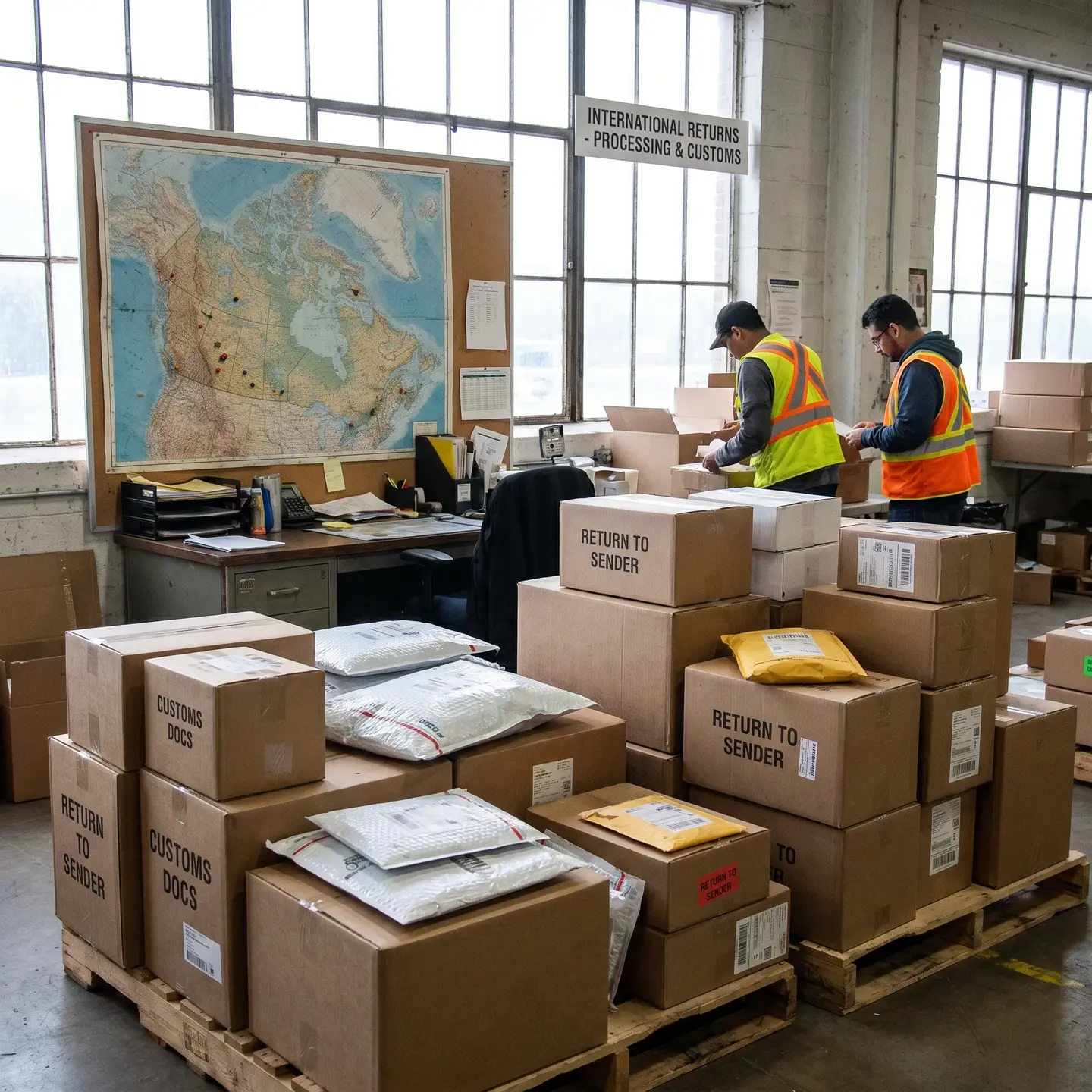
When international brands position inventory within Canada using Canadian fulfillment infrastructure, they fundamentally transform the returns equation. What would be complex international returns become simple domestic Canadian returns.
The Cost Differential in Practice
Consider a US wellness brand selling supplements into Canada:
Without Canadian fulfillment:
- Return shipping to US warehouse: $28 average
- Transit time: 7-14 days
- Customer refund delay: 14-21 days total
- Many products written off due to temperature exposure during extended transit
With Canadian fulfillment:
- Return shipping to Canadian facility: $9 average
- Transit time: 2-5 days
- Customer refund delay: 5-7 days total
- Products inspected and restocked within controlled environments
The $19 per-return savings compounds quickly. But beyond direct costs, the customer experience improvement drives repeat purchases and positive reviews—revenue that never appears on a return shipping report but materially impacts long-term profitability.
Beyond Shipping: The Full Returns Advantage
In-country fulfillment positioning provides returns benefits beyond shipping cost reduction:
- Faster inventory reintegration: Resalable products return to available stock in days rather than weeks, improving inventory turns and reducing out-of-stock situations
- Quality inspection consistency: Products are inspected in controlled facility environments rather than arriving after lengthy international transit
- Regulatory compliance continuity: Products never leave Canadian regulatory jurisdiction, simplifying restocking decisions for regulated categories
- Customer service simplification: Standard domestic tracking and predictable timelines reduce support inquiries
- Competitive return policies: Brands can offer free or low-cost returns that match Canadian market expectations
This positioning represents a strategic investment that pays dividends across the entire customer lifecycle, not just the returns process. When customers know returns are easy, they purchase with greater confidence—research from the Zion Market Research projects global B2C ecommerce reaching $5.5 trillion by 2027, with a 14.4% compound annual growth rate. Brands positioned to capture this growth need returns processes that support rather than undermine expansion.
Inventory Disposition Strategies for Returned Products
Once a return arrives at your Canadian fulfillment center, clear disposition protocols determine whether you recover value or absorb losses. Working with a 3PL that offers comprehensive reverse logistics capabilities ensures each returned item follows the appropriate pathway.
Restocking Protocols for Resalable Items
The fastest path to margin recovery is restocking products that meet resale standards:
- Visual inspection: Check packaging integrity, seal condition, and any signs of use or damage
- Inventory system update: Return item to available stock with appropriate notation
- Lot tracking verification: Ensure products with expiration dates remain within acceptable windows
- Location assignment: Place in appropriate warehouse zone for temperature or handling requirements
Products passing inspection return to saleable inventory typically within 24-48 hours of receipt at facilities with efficient returns processing infrastructure.
Managing Damaged and Opened Products
Not all returns can be restocked. Clear protocols for non-resalable items prevent inventory contamination and support accurate financial accounting:
- Damaged in transit: Document condition, file carrier claims where applicable, route to disposal or liquidation
- Customer-caused damage: Assess against return policy terms, route accordingly
- Opened but unused: Evaluate category-specific regulations—some products can be restocked, others cannot
- Opened and used: Route to appropriate disposal channel; never restock
Liquidation and Disposal Options Within Canada
International brands can’t economically ship non-resalable returns back to their home market. Canadian disposition options include:
- Secondary market liquidation: Sell through Canadian discount channels or liquidation partners
- Donation programs: Partner with Canadian charities for tax-advantaged disposal of suitable products
- Recycling: Route packaging and applicable products through Canadian recycling streams
- Compliant destruction: For products that cannot be resold, donated, or recycled, ensure environmentally appropriate disposal
The key insight is that international brands need Canadian disposition pathways. Trying to manage non-resalable returns from outside the country creates delays, costs, and compliance risks that erode any potential value recovery.
Building Returns Into Your Canadian Fulfillment Strategy
Returns management should be a front-end strategic decision made during market expansion planning, not an afterthought addressed when margins start eroding. Here’s a framework for evaluating your approach.
Return Policy Design for the Canadian Market
Effective return policies balance customer satisfaction with cost control:
- Return windows: 30-day windows are standard in Canada; shorter windows may reduce returns but also reduce conversion
- Condition requirements: Clearly specify acceptable return conditions to set expectations and support inspection decisions
- Free vs. paid returns: For products with healthy margins, free returns drive conversion; for lower-margin items, reasonable return shipping fees may be appropriate
- Exchange incentives: Offering free exchanges while charging for refund returns can retain revenue while satisfying customers
Fulfillment Partner Evaluation Criteria
When selecting a Canadian fulfillment partner, evaluate reverse logistics capabilities alongside outbound performance:
- Returns processing infrastructure: Dedicated returns receiving, inspection areas, and trained staff
- Platform integration: Seamless connection between returns initiation in your ecommerce platform and warehouse processing
- Inspection protocols: Clear, documented procedures for evaluating returned products
- Disposition flexibility: Multiple pathways for resalable, damaged, and non-returnable products
- Reporting and visibility: Real-time tracking of returns status and aggregated analytics on return patterns
Measuring True Returns Costs
Many brands track return shipping costs while missing hidden expenses:
- Customer service time: Each return inquiry consumes support resources
- Inventory depreciation: Products lose value during extended processing cycles
- Disposal costs: Non-resalable items require handling and disposal
- Opportunity cost: Capital tied up in returns processing isn’t available for growth
- Customer lifetime value impact: Poor returns experiences reduce repeat purchases
Comprehensive returns cost accounting reveals the true margin impact and justifies investment in optimized returns infrastructure.
Regulated Product Considerations in Returns Processing
For brands selling natural health products, cosmetics, food items, or other regulated categories, returns processing introduces additional complexity that requires specialized handling through regulated product fulfillment infrastructure.
NHP and Cosmetics Returns
Natural health products and cosmetics face strict requirements for restocking:
- Seal integrity: Products with broken seals typically cannot be restocked
- Temperature exposure: Items requiring controlled storage may be compromised after customer handling
- Lot tracking: Returned products must be traced to original lots for quality control
- Expiration management: Products approaching expiration may not be viable for restocking
Working with a 3PL holding documented compliance credentials—such as an Intertek SAI Global certification with Superior rating—ensures that returns processing maintains the same standards as outbound fulfillment.
Food Product Returns
Food items face the most restrictive returns requirements:
- Temperature-controlled products: Often cannot be restocked after leaving controlled environments
- Opened packaging: Never eligible for restocking regardless of apparent condition
- Best-before dating: Returns approaching dates may require immediate disposition
- CFIA compliance: All handling must meet Canadian Food Inspection Agency requirements
For food brands, returns management strategy should emphasize prevention—accurate product descriptions, clear allergen information, and sizing guidance—rather than efficient processing of high return volumes.
The Compliance Continuity Advantage
When regulated products are fulfilled from within Canada, returns never leave Canadian regulatory jurisdiction. This simplifies restocking decisions because:
- Products haven’t crossed international borders with associated temperature and handling uncertainties
- Lot tracking and documentation remain within a single regulatory framework
- Inspection and disposition decisions follow Canadian standards without reconciliation to foreign regulations
This compliance continuity represents a significant advantage for regulated product brands using Canadian fulfillment infrastructure. Combined with customs compliance expertise for inbound inventory, brands maintain regulatory confidence throughout the product lifecycle.
Strategic Positioning: Returns as Competitive Advantage
International brands entering the Canadian market have a choice: treat returns as an unavoidable cost to be minimized, or position returns management as a competitive advantage that drives customer acquisition and retention.
The brands that thrive treat returns strategically by:
- Planning returns infrastructure during market entry: Not as an afterthought when margins erode
- Selecting fulfillment partners for reverse logistics capability: Not just outbound performance
- Offering competitive return policies: Matching Canadian market expectations
- Measuring true returns costs: Including hidden expenses and customer lifetime value impact
- Building disposition pathways: Within Canada rather than attempting international recovery

With global B2C ecommerce growing at 14.4% annually and 66% of Gen Z shoppers purchasing internationally, the opportunity for international brands in Canada continues to expand. Capturing that opportunity requires operational infrastructure that supports the full customer journey—including the return journey.
At Ottawa Logistics Fulfillment, we’ve operated since 1918 and process over 40,000 orders weekly across our Ottawa, Toronto, and Vancouver facilities. Our reverse logistics capabilities transform what would be complex international returns into straightforward domestic Canadian processing, protecting margins while maintaining customer satisfaction. For brands serious about Canadian market success, returns management isn’t a cost center to minimize—it’s a strategic capability to build.
Frequently Asked Questions
The main benefit is speed and simplicity. Products can be inspected, restocked, or disposed of faster, which helps reduce refunds delays, customer complaints, and inventory losses.
It can cut return shipping costs sharply, often from roughly $20–$35 cross-border to about $6–$12 domestically. At scale, that difference can recover thousands in monthly margin.
Look for dedicated returns processing, clear inspection rules, platform integration, and multiple disposition options for resalable or damaged products. Those capabilities help protect margin and keep returns from becoming a hidden cost sink.
Usually only when the product value is too low to justify the return shipping and handling cost. For most D2C products priced above $30, write-offs tend to be more expensive than proper returns processing.
Because cross-border returns add shipping, customs, and processing delays on top of the refund itself. That makes each return much more expensive than a local Canadian return.

Scale Your Canada Fulfillment with Confidence.
Partner with Canada's premier 3PL to unlock faster shipping, lower costs, and seamless scalability for your ecommerce brand.
Talk to an Expert